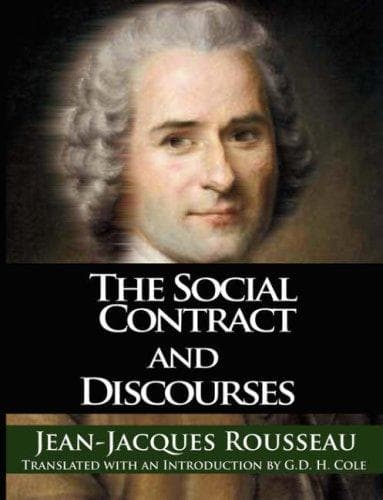
The social contract & discoursesRousseau, Jean-Jacques
Philosophy
The social contract & discourses
Rousseau, Jean-Jacques
Economics; Political science -- Early works to 1800; Social contract
It is easy to perceive that it is in these successive changes in
the constitution of man that we must look for the origin of those
differences which now distinguish men, who, it is allowed, are as equal
among themselves as were the animals of every kind, before physical
causes had introduced those varieties which are now observable among
some of them.
It is, in fact, not to be conceived that these primary changes, however
they may have arisen, could have altered, all at once and in the same
manner, every individual of the species. It is natural to think that,
while the condition of some of them grew better or worse, and they
were acquiring various good or bad qualities not inherent in their
nature, there were others who continued a longer time in their original
condition. Such was doubtless the first source of the inequality of
mankind, which it is much easier to point out thus in general terms,
than to assign with precision to its actual causes.
Let not my readers therefore imagine that I flatter myself with having
seen what it appears to me so difficult to discover. I have here
entered upon certain arguments, and risked some conjectures, less in
the hope of solving the difficulty, than with a view to throwing some
light upon it, and reducing the question to its proper form. Others may
easily proceed farther on the same road, and yet no one find it very
easy to get to the end. For it is by no means a light undertaking to
distinguish properly between what is original and what is artificial
in the actual nature of man, or to form a true idea of a state which
no longer exists, perhaps never did exist, and probably never will
exist; and of which, it is, nevertheless, necessary to have true
ideas, in order to form a proper judgment of our present state. It
requires, indeed, more philosophy than can be imagined to enable any
one to determine exactly what precautions he ought to take, in order
to make solid observations on this subject; and it appears to me that
a good solution of the following problem would be not unworthy of the
Aristotles and Plinys of the present age. _What experiments would have
to be made, to discover the natural man? And how are those experiments
to be made in a state of society_?
So far am I from undertaking to solve this problem, that I think I have
sufficiently, considered the subject, to venture to declare beforehand
that our greatest philosophers would not be too good to direct such
experiments, and our most powerful sovereigns to make them. Such a
combination we have very little reason to expect, especially attended
with the perseverance, or rather succession of intelligence and
good-will necessary on both sides to success.
Public-domain text, read in full here on John Shaqi.
Reviews
Reviews
No reviews yet
Be the first to share your thoughts on this work.
Elsewhere in the archive
Join the Discussion
Join the discussion
Sign in to leave a comment or review.
Sign InorCreate an account