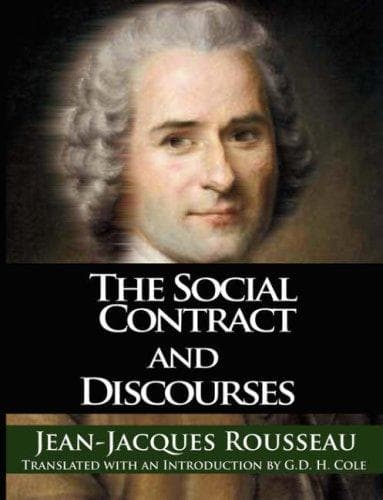
The social contract & discoursesRousseau, Jean-Jacques
Philosophy
The social contract & discourses
Rousseau, Jean-Jacques
Economics; Political science -- Early works to 1800; Social contract
Knowing so little of nature, and agreeing so ill about the meaning
of the word _law_, it would be difficult for us to fix on a good
definition of natural law. Thus all the definitions we meet with in
books, setting: aside their defect in point of uniformity, have yet
another fault, in that they are derived from many kinds of knowledge,
which men do not possess naturally, and from advantages of which they
can have no idea until they have already departed from that state.
Modern writers begin by inquiring what rules it would be expedient
for men to agree on for their common interest, and then give the name
of natural law to a collection of these rules, without any other
proof than the good that would result from their being universally
practised. This is undoubtedly a simple way of making definitions, and
of explaining the nature of things by almost arbitrary conveniences.
But as long as we are ignorant of the natural man, it is in vain for us
to attempt to determine either the law originally prescribed to him, or
that which is best adapted to his constitution. All we can know with
any certainty respecting this law is that, if it is to be a law, not
only the wills of those it obliges must be sensible of their submission
to it; but also, to be natural, it must come directly from the voice of
nature.
Throwing aside, therefore, all those scientific books, which teach us
only to see men such as they have made themselves, and contemplating
the first and most simple operations of the human soul, I think I can
perceive in it two principles prior to reason, one of them deeply
interesting us in our own welfare and preservation, and the other
exciting a natural repugnance at seeing any other sensible being, and
particularly any of our own species, suffer pain or death. It is from
the agreement and combination which the understanding is in a position
to establish between these two principles, without its being necessary
to introduce that of sociability, that all the rules of natural right
appear to me to be derived--rules which our reason is afterwards
obliged to establish on other foundations, when by its successive
developments it has been led to suppress nature itself.
Public-domain text, read in full here on John Shaqi.
Reviews
Reviews
No reviews yet
Be the first to share your thoughts on this work.
Elsewhere in the archive
Join the Discussion
Join the discussion
Sign in to leave a comment or review.
Sign InorCreate an account