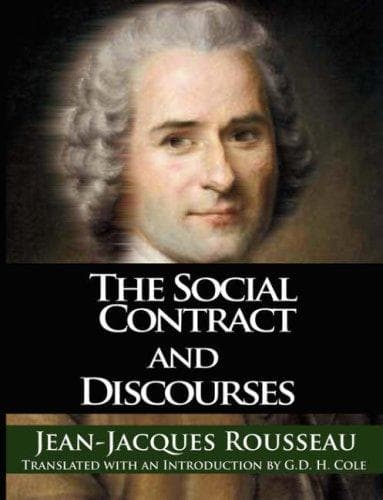
The social contract & discoursesRousseau, Jean-Jacques
Philosophy
The social contract & discourses
Rousseau, Jean-Jacques
Economics; Political science -- Early works to 1800; Social contract
These investigations, which are so difficult to make, and have been
hitherto so little thought of, are, nevertheless, the only means that
remain of obviating a multitude of difficulties which deprive us of
the knowledge of the real foundations of human society. It is this
ignorance of the nature of man, which casts so much uncertainty and
obscurity on the true definition of natural right: for, the idea of
right, says Burlamaqui, and more particularly that of natural right,
are ideas manifestly relative to the nature of man. It is then from
this very nature itself, he goes on, from the constitution and state of
man, that we must deduce the first principles of this science.
We cannot see without surprise and disgust how little agreement there
is between the different authors who have treated this great subject.
Among the more important writers there are scarcely two of the same
mind about it. Not to speak of the ancient philosophers, who seem
to have done their best purposely to contradict one another on the
most fundamental principles, the Roman jurists subjected man and the
other animals indiscriminately to the same natural law, because they
considered, under that name, rather the law which nature imposes on
herself than that which she prescribes to others; or rather because
of the particular acceptation of the term law among those jurists;
who seem on this occasion to have understood nothing more by it than
the general relations established by nature between all animated
beings, for their common preservation. The moderns, understanding,
by the term law, merely a rule prescribed to a moral being, that is
to say intelligent, free and considered in his relations to other
beings, consequently confine the jurisdiction of natural law to man,
an the only animal endowed with reason. But, defining this law, each
after his own fashion, they have established it on such metaphysical
principles, that there are very few persons among us capable of
comprehending them, much less of discovering them for themselves. So
that the definitions of these learned men, all differing in everything
else, agree only in this, that it is impossible to comprehend the law
of nature, and consequently to obey it, without being a very subtle
casuist and a profound metaphysician. All which is as much as to say
that mankind must have employed, in the establishment of society, a
capacity which is acquired only with great difficulty, and by very few
persons, even in a state of society.
Public-domain text, read in full here on John Shaqi.
Reviews
Reviews
No reviews yet
Be the first to share your thoughts on this work.
Elsewhere in the archive
Join the Discussion
Join the discussion
Sign in to leave a comment or review.
Sign InorCreate an account