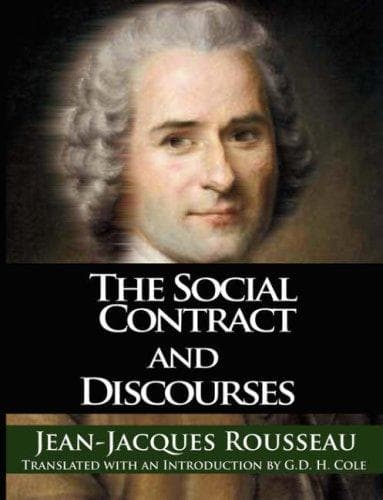
The social contract & discoursesRousseau, Jean-Jacques
Philosophy
The social contract & discourses
Rousseau, Jean-Jacques
Economics; Political science -- Early works to 1800; Social contract
O man, of whatever country you are, and whatever your opinions may be,
behold your history, such as I have thought to read it, not in books
written by your fellow-creatures, who are liars, but in nature, which
never lies. All that comes from her will be true; nor will you meet
with anything false, unless I have involuntarily put in something of my
own. The times of which I am going to speak are very remote: how much
are you changed from what you once were! It is so to speak, the life of
your species which I am going to write, after the qualities which you
have received, which your education and habits may have depraved, but
cannot have entirely destroyed. There is, I feel, an age at which the
individual man would wish to stop; you are about to inquire about the
age at which you would have liked your whole species to stand still.
Discontented with your present state, for reasons which threaten your
unfortunate descendants with still greater discontent, you will perhaps
wish it were in your power to go back; and this feeling should be a
panegyric on your first ancestors, a criticism of your contemporaries,
and a terror to the unfortunates who will come after you.
THE FIRST PART
Important as it may be, in order to judge rightly of the natural state
of man, to consider him from his origin, and to examine him, as it
were, in the embryo of his species; I shall not follow his organisation
through its successive developments, nor shall I stay to inquire what
his animal system must have been at the beginning, in order to become
at length what it actually is. I shall not ask whether his long nails
were at first, as Aristotle supposes, only crooked talons; whether
his whole body, like that of a bear, was not covered with hair; or
whether the fact that he walked upon all fours, with his looks directed
toward the earth, confined to a horizon of a few paces, did not at
once point out the nature and limits of his ideas. On this subject. I
could form none but vague and almost imaginary conjectures. Comparative
anatomy has as yet made too little progress, and the observations of
naturalists are too uncertain, to afford an adequate basis for any
solid reasoning. So that, without having recourse to the supernatural
information given us on this head, or paying any regard to the changes
which must have taken place in the internal, as well as the external,
conformation of man, as he applied his limbs to new uses, and fed
himself on new kinds of food, I shall suppose his conformation to have
been at all times what it appears to us at this day; that he always
walked on two legs, made use of his hands as we do, directed his looks
over all nature, and measured with his eyes the vast expanse of Heaven.
Public-domain text, read in full here on John Shaqi.
Reviews
Reviews
No reviews yet
Be the first to share your thoughts on this work.
Elsewhere in the archive
Join the Discussion
Join the discussion
Sign in to leave a comment or review.
Sign InorCreate an account