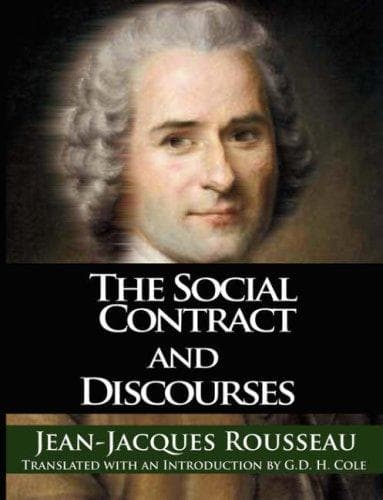
The social contract & discoursesRousseau, Jean-Jacques
Philosophy
The social contract & discourses
Rousseau, Jean-Jacques
Economics; Political science -- Early works to 1800; Social contract
Whatever moralists may hold, the human understanding is greatly
indebted to the passions, which, it is universally allowed, are also
much indebted to the understanding. It is by the activity of the
passions that pur reason is improved; for we desire knowledge only
because we wish to enjoy; and it is impossible to conceive any reason
why a person who has neither fears nor desires should give himself the
trouble of reasoning. The passions, again, originate in our wants,
and their progress depends on that of our knowledge; for we cannot
desire or fear anything, except from the idea we have of it, or from
the simple impulse of nature. Now savage man, being destitute of every
species of intelligence, can have no passions save those of the latter
kind: his desires never go beyond his physical wants. The only goods
he recognises in the universe are food, a female, and sleep: the only
evils he fears are pain and hunger. I say pain, and not death: for
no animal can know what it is to die; the knowledge of death and its
terrors being one of the first acquisitions made by man in departing
from an animal state.
It would be easy, were it necessary, to support this opinion by facts,
and to show that, in all the nations of the world, the progress
of the understanding has been exactly proportionate to the wants
which the peoples had received from nature, or been subjected to by
circumstances, and in consequence to the passions that induced them to
provide for those necessities. I might instance the arts, rising up in
Egypt and expanding with the inundation of the Nile. I might follow
their progress into Greece, where they took root afresh, grew up and
towered to the skies, among the rocks and sands of Attica, without
being able to germinate on the fertile banks of the Eurotas: I might
observe that in general, the people of the North are more industrious
than those of the South, because they cannot get on so well without
being so: as if nature wanted to equalise matters by giving their
understandings the fertility she had refused to their soil.
Public-domain text, read in full here on John Shaqi.
Reviews
Reviews
No reviews yet
Be the first to share your thoughts on this work.
Elsewhere in the archive
Join the Discussion
Join the discussion
Sign in to leave a comment or review.
Sign InorCreate an account