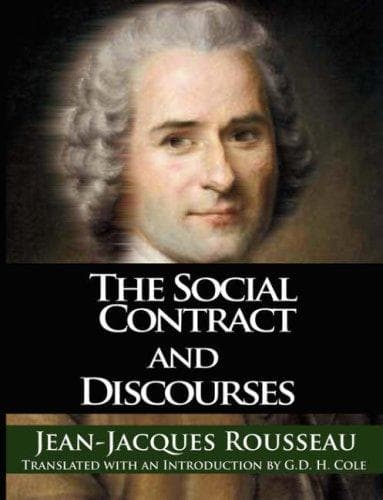
The social contract & discoursesRousseau, Jean-Jacques
Philosophy
The social contract & discourses
Rousseau, Jean-Jacques
Economics; Political science -- Early works to 1800; Social contract
taught them by the gods, since it is not to be conceived how they
could discover them for themselves--yet after all this, what man among
them would be so absurd as to take the trouble of cultivating a field,
which might be stripped of its crop by the first comer, man or beast,
that might take a liking to it; and how should each of them resolve to
pass his life in wearisome labour, when, the more necessary to him the
reward of his labour might be, the surer he would be of not getting
it? In a word, how could such a situation induce men to cultivate the
earth, till it was regularly parcelled out among them; that is to say,
till the state of nature had been abolished?
Were we to suppose savage man as trained in the art of thinking as
philosophers make him; were we, like them, to suppose him a very
philosopher capable of investigating the sublimest truths, and of
forming, by highly abstract chains of reasoning, maxims of reason and
justice, deduced from the love of order in general, or the known will
of his Creator; in a word, were we to suppose him as intelligent and
enlightened, as he must have been, and is in fact found to have been,
dull and stupid, what advantage Would accrue to the species, from all
such metaphysics, which could not be communicated by one to another,
but must end with him who made them? What progress could be made by
mankind, while dispersed in the woods among other animals? and how far
could men improve or mutually enlighten one another, when, having no
fixed habitation, and no need of one another's assistance, the same
persons hardly met twice in their lives, and perhaps then, without
knowing one another or speaking together?
Let it be considered how many ideas we owe to the use of speech; how
far grammar exercises the understanding and facilitates its operations.
Let us reflect on the inconceivable pains and the infinite space of
time that the first invention of languages must have cost. To these
reflections add what preceded, and then judge how many thousand ages
must have elapsed in the successive development in the human mind of
those operations of which it is capable.
Public-domain text, read in full here on John Shaqi.
Reviews
Reviews
No reviews yet
Be the first to share your thoughts on this work.
Elsewhere in the archive
Join the Discussion
Join the discussion
Sign in to leave a comment or review.
Sign InorCreate an account