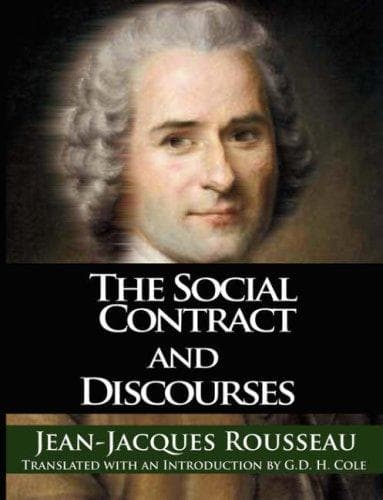
The social contract & discoursesRousseau, Jean-Jacques
Philosophy
The social contract & discourses
Rousseau, Jean-Jacques
Economics; Political science -- Early works to 1800; Social contract
together at riots and street-brawls, while the wise man prudently makes
off. It is the mob and the market-women, who part the combatants, and
hinder gentle-folks from cutting one another's throats.
It is then certain that compassion is a natural feeling which, by
moderating the violence of love of self in each individual, contributes
to the preservation of the whole species. It is this compassion that
hurries us without reflection to the relief of those who are in
distress: it is this which in a state of nature supplies the place of
laws, morals and virtues, with the advantage that none are tempted to
disobey its gentle voice: it is this which will always prevent a sturdy
savage from robbing a weak child or a feeble old man of the sustenance
they may have with pain and difficulty acquired, if he sees a
possibility of providing for himself by other means: it is this which,
instead of inculcating that sublime maxim of rational justice, _Do to
others as you would have them do unto you,_ inspires all men with that
other maxim of natural goodness, much less perfect indeed, but perhaps
more useful; _Do good to yourself with as little evil as possible to
others._ In a word, it is rather in this natural feeling than in any
subtle arguments that we must look for the cause of that repugnance,
which every man would experience in doing evil, even independently of
the maxims of education. Although it might belong to Socrates and other
minds of the like craft to acquire virtue by reason, the human race
would long since have ceased to be, had its preservation depended only
on the reasonings of the individuals composing it.
With passions so little active, and so good a curb, men, being rather
wild than wicked, and more intent to guard themselves against the
mischief that might be done them, than to do mischief to others, were
by no means subject to very perilous dissensions. They maintained no
kind of intercourse with one another, and were consequently strangers
to vanity, deference, esteem and contempt; they had not the least
idea of _meum_ and _tuum_, and no true conception of justice; they
looked upon every violence to which they were subjected, rather as an
injury that might easily be repaired than as a crime that ought to be
punished; and they never thought of taking revenge, unless perhaps
mechanically and on the spot, as a dog will sometimes bite the stone
which is thrown at him. Their quarrels therefore would seldom have
very bloody consequences; for the subject of them would be merely the
question of subsistence. But I am aware of one greater danger, which
remains to be noticed.
Public-domain text, read in full here on John Shaqi.
Reviews
Reviews
No reviews yet
Be the first to share your thoughts on this work.
Elsewhere in the archive
Join the Discussion
Join the discussion
Sign in to leave a comment or review.
Sign InorCreate an account