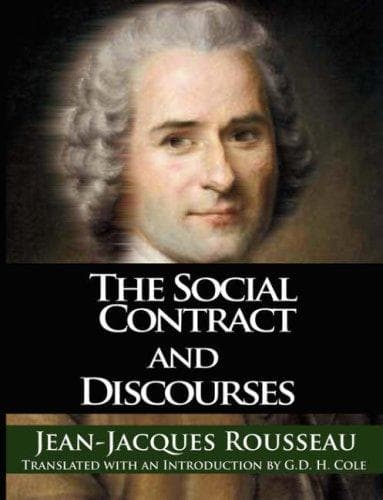
The social contract & discoursesRousseau, Jean-Jacques
Philosophy
The social contract & discourses
Rousseau, Jean-Jacques
Economics; Political science -- Early works to 1800; Social contract
Men in a state of nature being confined merely to what is physical in
love, and fortunate enough to be ignorant of those excellences, which
whet the appetite while they increase the difficulty of gratifying
it, must be subject to fewer and less violent fits of passion,
and consequently fall into fewer and less violent disputes. The
imagination, which causes such ravages among us, never speaks to the
heart of savages, who quietly await the impulses of nature, yield to
them involuntarily, with more pleasure than ardour, and, their wants
once satisfied, lose the desire. It is therefore incontestable that
love, as well as all other passions, must have acquired in society
that glowing impetuosity, which makes it so often fatal to mankind.
And it is the more absurd to represent savages as continually cutting
one another's throats to indulge their brutality, because this opinion
is directly contrary to experience; the Caribeans, who have as yet
least of all deviated from the state of nature, being in fact the most
peaceable of people in their amours, and the least subject to jealousy,
though they live in a hot climate which seems always to inflame the
passions.
With regard to the inferences that might be drawn, in the case of
several species of animals, the males of which fill our poultry-yards
with blood and slaughter, or in spring make the forests resound with
their quarrels over their females; we must begin by excluding all those
species, in which nature has plainly established, in the comparative
power of the sexes, relations different from those which exist among
us: thus we can base no conclusion about men on the habits of fighting
cocks. In those species where the proportion is better observed, these
battles must be entirely due to the scarcity of females in comparison
with males; or, what amounts to the same thing, to the intervals during
which the female constantly refuses the advances of the male: for if
each female admits the male but during two months in the year, it
is the same as if the number of females were five-sixths less. Now,
neither of these two cases is applicable to the human species, in
which the number of females usually exceeds that of males, and among
whom it has never been observed, even among savages, that the females
have, like those of other animals, their stated times of passion and
indifference. Moreover, in several of these species, the individuals
all take fire at once, and there comes a fearful moment of universal
passion, tumult and disorder among them; a scene which is never beheld
in the human species, whose love is not thus seasonal. We must not
then conclude from the combats of such animals for the enjoyment of
the females, that the case would be the same with mankind in a state
of nature: and, even if we drew such a conclusion, we see that such
contests do not exterminate other kinds of animals, and we have no
reason to think they would be more fatal to ours. It is indeed clear
Public-domain text, read in full here on John Shaqi.
Reviews
Reviews
No reviews yet
Be the first to share your thoughts on this work.
Elsewhere in the archive
Join the Discussion
Join the discussion
Sign in to leave a comment or review.
Sign InorCreate an account