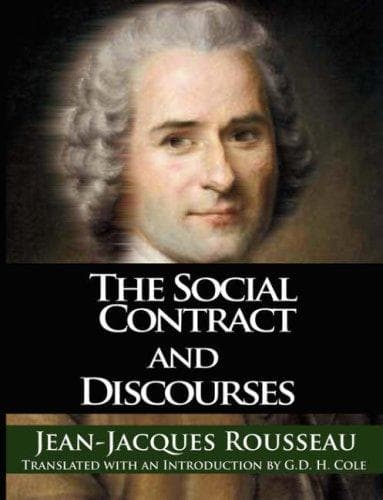
The social contract & discoursesRousseau, Jean-Jacques
Philosophy
The social contract & discourses
Rousseau, Jean-Jacques
Economics; Political science -- Early works to 1800; Social contract
It is in fact easy to see that many of the differences which
distinguish men are merely the effect of habit and the different
methods of life men adopt in society. Thus a robust or delicate
constitution, and the strength or weakness attaching to it, are more
frequently the effects of a hardy or effeminate method of education
than of the original endowment of the body. It is the same with the
powers of the mind; for education not only makes a difference between
such as are cultured and such as are not, but even increases the
differences which exist among the former, in proportion to their
respective degrees of culture: as the distance between a giant and
a dwarf on the same road increases with every step they take. If we
compare the prodigious diversity, which obtains in the education and
manner of life of the various orders of men in the state of society,
with the uniformity and simplicity of animal and savage life, in
which every one lives on the same kind of food and in exactly the
same manner, and does exactly the same things, it is easy to conceive
how much less the difference between man and man must be in a state
of nature than in a state of society, and how greatly the natural
inequality of mankind must be increased by the inequalities of social
institutions.
But even if nature really affected, in the distribution of her gifts,
that partiality which is imputed to her, what advantage would the
greatest of her favourites derive from it, to the detriment of others,
in a state that admits of hardly any kind of relation between them?
Where there is no love, of what advantage is beauty? Of what use is wit
to those who do not converse, or cunning to those who have no business
with others? I hear it constantly repeated that, in such a state, the
strong would oppress the weak; but what is here meant by oppression?
Some, it is said, would violently domineer over others, who would
groan under a servile submission to their caprices. This indeed is
exactly what I observe to be the case among us; but I do not see how
it can be inferred of men in a state of nature, who could not easily
be brought to conceive what we mean by dominion and servitude. One
man, it is true, might seize the fruits which another had gathered,
the game he had killed, or the cave he had chosen for shelter; but how
would he ever be able to exact obedience, and what ties of dependence
could there be among men without possessions? If, for instance, I am
driven from one tree, I can go to the next; if I am disturbed in one
place, what hinders me from going to another? Again, should I happen to
meet with a man so much stronger than myself, and at the same time so
depraved, so indolent, and so barbarous, as to compel me to provide for
his sustenance while he himself remains idle; he must take care not to
have his eyes off me for a single moment; he must bind me fast before
he goes to sleep, or I shall certainly either knock him on the head
or make my escape.
Public-domain text, read in full here on John Shaqi.
Reviews
Reviews
No reviews yet
Be the first to share your thoughts on this work.
Elsewhere in the archive
Join the Discussion
Join the discussion
Sign in to leave a comment or review.
Sign InorCreate an account