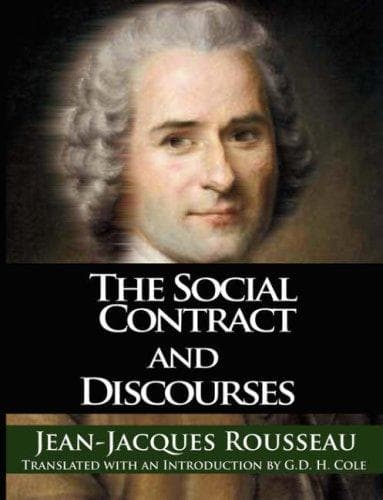
The social contract & discoursesRousseau, Jean-Jacques
Philosophy
The social contract & discourses
Rousseau, Jean-Jacques
Economics; Political science -- Early works to 1800; Social contract
That is to say, he must in such a case voluntarily
expose himself to much greater trouble than he seeks to avoid, or can
give me. After all this, let him be off his guard ever so little;
let him but turn his head aside at any sudden noise, and I shall be
instantly twenty paces off, lost in the forest, and, my fetters burst
asunder, he would never see me again.
Without my expatiating thus uselessly on these details, every one
must see that as the bonds of servitude are formed merely by the
mutual dependence of men on one another and the reciprocal needs that
unite them, it is impossible to make any man a slave, unless he be
first reduced to a situation in which he cannot do without the help
of others: and, since such a situation does not exist in a state of
nature, every one is there his own master, and the law of the strongest
is of no effect.
Having proved that the inequality of mankind is hardly felt, and that
its influence is next to nothing in a state of nature, I must next
show its origin and trace its progress in the successive developments
of the human mind. Having shown that human _perfectibility_, the
social virtues, and the other faculties which natural man potentially
possessed, could never develop of themselves, but must require the
fortuitous concurrence of many foreign causes that might never arise,
and without which he would have remained for ever in his primitive
condition, I must now collect and consider the different accidents
which may have improved the human understanding while depraving the
species, and made man wicked while making him sociable; so as to bring
him and the world from that distant period to the point at which we now
behold them.
I confess that, as the events I am going to describe might have
happened in various ways, I have nothing to determine my choice but
conjectures: but such conjectures become reasons, when they are the
most probable that can be drawn from the nature of things, and the only
means of discovering the truth. The consequences, however, which I mean
to deduce will not be barely conjectural; as, on the principles just
laid down, it would be impossible to form any other theory that would
not furnish the same results, and from which I could not draw the same
conclusions.
Public-domain text, read in full here on John Shaqi.
Reviews
Reviews
No reviews yet
Be the first to share your thoughts on this work.
Elsewhere in the archive
Join the Discussion
Join the discussion
Sign in to leave a comment or review.
Sign InorCreate an account