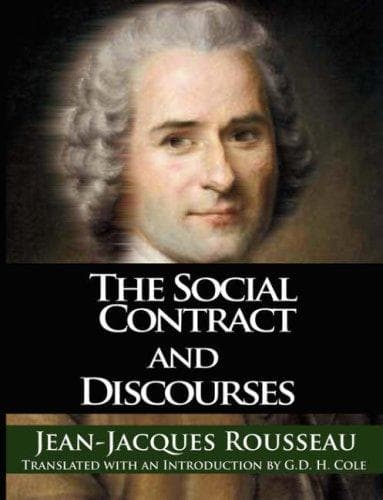
The social contract & discoursesRousseau, Jean-Jacques
Philosophy
The social contract & discourses
Rousseau, Jean-Jacques
Economics; Political science -- Early works to 1800; Social contract
Such was, or may well have been, the origin of society and law, which
bound new fetters on the poor, and gave new powers to the rich; which
irretrievably destroyed natural liberty, eternally fixed the law of
property and inequality, converted clever usurpation into unalterable
right, and, for the advantage of a few ambitious individuals, subjected
all mankind to perpetual labour, slavery and wretchedness. It is easy
to see how the establishment of one community made that of all the
rest necessary, and how, in order to make head against united forces,
the rest of mankind had to unite in turn. Societies soon multiplied
and spread over the face of the earth, till hardly a corner of the
world was left in which a man could escape the yoke, and withdraw
his head from beneath the sword which he saw perpetually hanging
over him by a thread. Civil right having thus become the common rule
among the members of each community, the law of nature maintained its
place only between different communities, where, under the name of
the right of nations, it was qualified by certain tacit conventions,
in order to make commerce practicable, and serve as a substitute for
natural compassion, which lost, when applied to societies, almost
all the influence it had over individuals, and survived no longer
except in some great cosmopolitan spirits, who, breaking down the
imaginary barriers that separate different peoples, follow the example
of our Sovereign Creator, and include the whole human race in their
benevolence.
But bodies politic, remaining thus in a state of nature among
themselves, presently experienced the inconveniences which had obliged
individuals to forsake it; for this state became still more fatal
to these great bodies than it had been to the individuals of whom
they were composed. Hence arose national wars, battles, murders, and
reprisals, which shock nature and outrage reason; together with all
those horrible prejudices which class among the virtues the honour
of shedding human blood. The most distinguished men hence learned to
consider cutting each other's throats a duty; at length men massacred
their fellow-creatures by thousands without so much as knowing why, and
committed more murders in a single day's fighting, and more violent
outrages in the sack of a single town, than were committed in the state
of nature during whole ages over the whole earth. Such were the first
effects which we can see to have followed the division of mankind into
different communities. But let us return to their institutions.
Public-domain text, read in full here on John Shaqi.
Reviews
Reviews
No reviews yet
Be the first to share your thoughts on this work.
Elsewhere in the archive
Join the Discussion
Join the discussion
Sign in to leave a comment or review.
Sign InorCreate an account