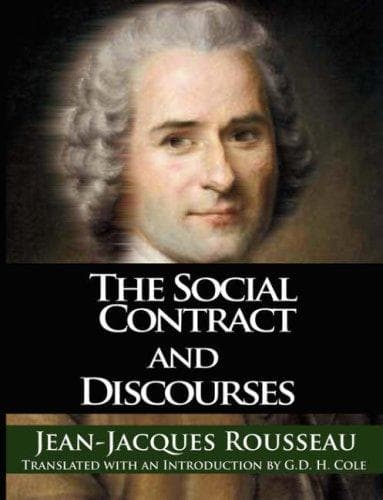
The social contract & discoursesRousseau, Jean-Jacques
Philosophy
The social contract & discourses
Rousseau, Jean-Jacques
Economics; Political science -- Early works to 1800; Social contract
I shall not stay here to inquire whether, as liberty is the noblest
faculty of man, it is not degrading our very nature, reducing ourselves
to the level of the brutes, which are mere slaves of instinct, and even
an affront to the Author of our being, to renounce without reserve
the most precious of all His gifts, and to bow to the necessity
of committing all the crimes He has forbidden, merely to gratify a
mad or a cruel master; or if this sublime craftsman ought not to be
less angered at seeing His workmanship entirely destroyed than thus
dishonoured. I will waive (if my opponents please) the authority of
Barbeyrac, who, following Locke, roundly declares that no man can so
far sell his liberty as to submit to an arbitrary power which may
use him as it likes. _For_, he adds, _this would be to sell his own
life, of which he is not master_. I shall ask only what right those
who were not afraid thus to debase themselves could have to subject
their posterity to the same ignominy, and to renounce for them those
blessings which they do not owe to the liberality of their progenitors,
and without which life itself must be a burden to all who are worthy of
it.
Puffendorf says that we may divest ourselves of our liberty in favour
of other men, just as we transfer our property from one to another by
contracts and agreements. But this seems a very weak argument. For in
the first place, the property I alienate becomes quite foreign to me,
nor can I suffer from the abuse of it; but it very nearly concerns me
that my liberty should not be abused, and I cannot without incurring
the guilt of the crimes I may be compelled to commit, expose myself
to become an instrument of crime. Besides, the right of property
being only a convention of human institution, men may dispose of
what they possess as they please: but this is not the case with the
essential gifts of nature, such as life and liberty, which every man is
permitted to enjoy, and of which it is at least doubtful whether any
have a right to divest themselves. By giving up the one, we degrade
our being; by giving up the other, we do our best to annul it; and,
as no temporal good can indemnify us for the loss of either, it would
be an offence against both reason and nature to renounce them at any
price whatsoever. But, even if we could transfer our liberty, as we
do our property, there would be a great difference with regard to the
children, who enjoy the father's substance only by the transmission of
his right; whereas, liberty being a gift which they hold from nature
as being men, their parents have no right whatever to deprive them of
it. As then, to establish slavery, it was necessary to do violence to
nature, so, in order to perpetuate such a right, nature would have to
be changed. Jurists, who have gravely determined that the child of a
slave comes into the world a slave, have decided, in other words, that
a man shall come into the world not a man.
Public-domain text, read in full here on John Shaqi.
Reviews
Reviews
No reviews yet
Be the first to share your thoughts on this work.
Elsewhere in the archive
Join the Discussion
Join the discussion
Sign in to leave a comment or review.
Sign InorCreate an account