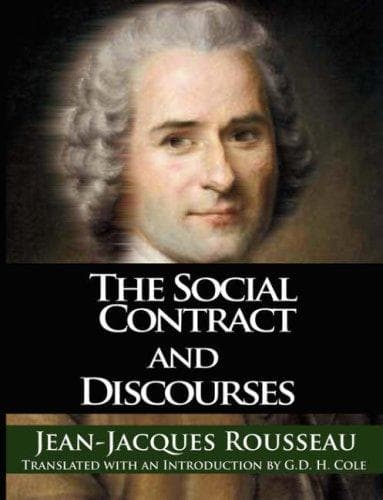
The social contract & discoursesRousseau, Jean-Jacques
Philosophy
The social contract & discourses
Rousseau, Jean-Jacques
Economics; Political science -- Early works to 1800; Social contract
I regard it then as certain, that government did not begin with
arbitrary power, but that this is the depravation, the extreme term,
of government, and brings it back, finally, to just the law of the
strongest, which it was originally designed to remedy. Supposing,
however, it had begun in this manner, such power, being in itself
illegitimate, could not have served as a basis for the laws of society,
nor, consequently, for the inequality they instituted.
Without entering at present upon the investigations which still remain
to be made into the nature of the fundamental compact underlying
all government, I content myself with adopting the common opinion
concerning it, and regard the establishment of the political body as
a real contract between the people and the chiefs chosen by them: a
contract by which both parties bind themselves to observe the laws
therein expressed, which form the ties of their union. The people
having in respect of their social relations concentrated all their
wills in one, the several articles, concerning which this will is
explained, become so many fundamental laws, obligatory on all the
members of the State without exception, and one of these articles
regulates the choice and power of the magistrates appointed to watch
over the execution of the rest. This power extends to everything which
may maintain the constitution, without going so far as to alter it.
It is accompanied by honours, in order to bring the laws and their
administrators into respect. The ministers are also distinguished by
personal prerogatives, in order to recompense them for the cares and
labour which good administration involves. The magistrate, on his side,
binds himself to use the power he is entrusted with only in conformity
with the intention of his constituents, to maintain them all in the
peaceable possession of what belongs to them, and to prefer on every
occasion the public interest to his own.
Before experience had shown, or knowledge of the human heart enabled
men to foresee, the unavoidable abuses of such a constitution, it must
have appeared so much the more excellent, as those who were charged
with the care of its preservation had themselves most interest in it;
for magistracy and the rights attaching to it being based solely on
the fundamental laws, the magistrates would cease to be legitimate as
soon as these ceased to exist; the people would no longer owe them
obedience; and as not the magistrates, but the laws, are essential to
the being of a State, the members of it would regain the right to their
natural liberty.
Public-domain text, read in full here on John Shaqi.
Reviews
Reviews
No reviews yet
Be the first to share your thoughts on this work.
Elsewhere in the archive
Join the Discussion
Join the discussion
Sign in to leave a comment or review.
Sign InorCreate an account