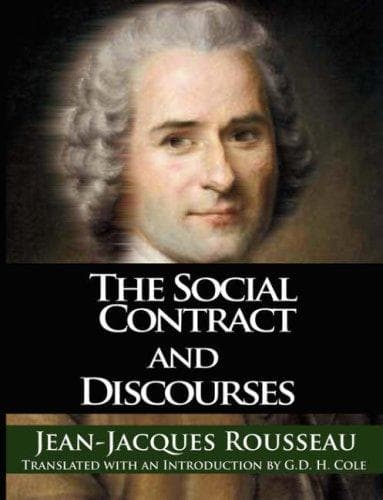
The social contract & discoursesRousseau, Jean-Jacques
Philosophy
The social contract & discourses
Rousseau, Jean-Jacques
Economics; Political science -- Early works to 1800; Social contract
It is from the midst of this disorder and these revolutions, that
despotism, gradually raising up its hideous head and devouring
everything that remained sound and untainted in any part of the State,
would at length trample on both the laws and the people, and establish
itself on the ruins of the republic. The times which immediately
preceded this last change would be times of trouble and calamity; but
at length the monster would swallow up everything, and the people would
no longer have either chiefs or laws, but only tyrants. From this
moment there would be no question of virtue or morality; for despotism
_cui ex honesto nulla est spes_, wherever it prevails, admits no other
master; it no sooner speaks than probity and duty lose their weight and
blind obedience is the only virtue which slaves can still practise.
This is the last term of inequality, the extreme points that closes
the circle, and meets that from which we set out. Here all private
persons return to their first equality, because they are nothing; and,
subjects having no law but the will of their master, and their master
no restraint but his passions, all notions of good and all principles
of equity again vanish. There is here a complete return to the law of
the strongest, and so to a new state of nature, differing from that we
set out from; for the one was a state of nature in its first purity,
while this is the consequence of excessive corruption. There is so
little difference between the two states in other respects, and the
contract of government is so completely dissolved by despotism, that
the despot is master only so long as he remains the strongest; as soon
as he can be expelled, he has no right to complain of violence. The
popular insurrection that ends in the death or deposition of a Sultan
is as lawful an act as those by which he disposed, the day before, of
the lives and fortunes of his subjects. As he was maintained by force
alone, it is force alone that overthrows him. Thus everything takes
place according to the natural order; and, whatever may be the result
of such frequent and precipitate revolutions, no one man has reason to
complain of the injustice of another, but only of his own ill-fortune
or indiscretion.
Public-domain text, read in full here on John Shaqi.
Reviews
Reviews
No reviews yet
Be the first to share your thoughts on this work.
Elsewhere in the archive
Join the Discussion
Join the discussion
Sign in to leave a comment or review.
Sign InorCreate an account