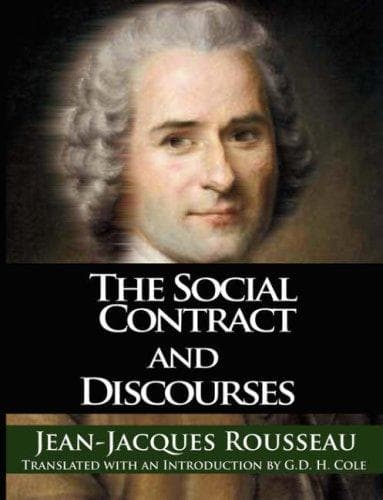
The social contract & discoursesRousseau, Jean-Jacques
Philosophy
The social contract & discourses
Rousseau, Jean-Jacques
Economics; Political science -- Early works to 1800; Social contract
[8] Distributive justice would oppose this rigorous equality of the
state of nature, even were it practicable in civil society; as all
the members of the State owe it their services in proportion to their
talents and abilities, they ought, on their side, to be distinguished
and favoured in proportion to the services they have actually rendered.
It is in this sense we must understand that passage of Isocrates, in
which he extols the primitive Athenians, for having determined which
of the two kinds of equality was the most useful, viz. that which
consists in dividing the same advantages indiscriminately among all the
citizens, or that which consists in distributing them to each according
to his deserts. These able politicians, adds the orator, banishing
that unjust inequality which makes no distinction between good and bad
men, adhered inviolably to that which rewards and punishes every man
according to his deserts.
But in the first place, there never existed a society, however corrupt
some may have become, where no difference was made between the good
and the bad; and with regard to morality, where no measures can be
prescribed by law exact enough to serve as a practical rule for a
magistrate, it is with great prudence that, in order not to leave the
fortune or quality of the citizens to his discretion, it prohibits him
from passing judgment on persons and confines his judgment to actions.
Only morals such as those of the ancient Romans can bear censors, and
such a tribunal among us would throw everything into confusion. The
difference between good and bad men is determined by public esteem; the
magistrate being strictly a judge of right alone; whereas the public is
the truest judge of morals, and is of such integrity and penetration on
this head, that although it may be sometimes deceived, it can never be
corrupted. The rank of citizens ought, therefore, to be regulated, not
according to their personal merit--for this would put it in the power
of the magistrate to apply the law almost arbitrarily--but according to
the actual services done to the State, which are capable of being more
exactly estimated.
APPENDIX[1]
Public-domain text, read in full here on John Shaqi.
Reviews
Reviews
No reviews yet
Be the first to share your thoughts on this work.
Elsewhere in the archive
Join the Discussion
Join the discussion
Sign in to leave a comment or review.
Sign InorCreate an account