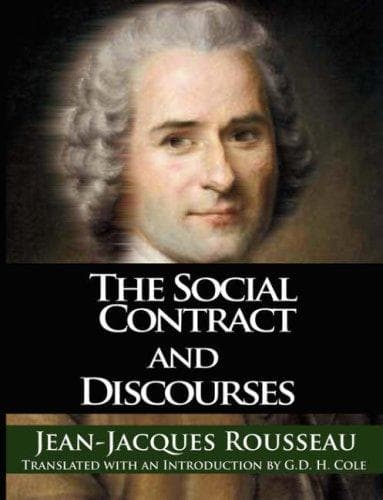
The social contract & discoursesRousseau, Jean-Jacques
Philosophy
The social contract & discourses
Rousseau, Jean-Jacques
Economics; Political science -- Early works to 1800; Social contract
A famous author, reckoning up the good and evil of human life, and
comparing the aggregates, finds that our pains greatly exceed our
pleasures: so that, all things considered, human life is not at all a
valuable gift. This conclusion does not surprise me; for the writer
drew all his arguments from man in civilisation. Had he gone back to
the state of nature, his inquiries would clearly have had a different
result, and man would have been seen to be subject to very few evils
not of his own creation. It has indeed cost us not a little trouble
to make ourselves as wretched as we are. When we consider, on the one
hand, the immense labours of mankind, the many sciences brought to
perfection, the arts invented, the powers employed, the deeps filled
up, the mountains levelled, the rocks shattered, the rivers made
navigable, the tracts of land cleared, the lakes emptied, the marshes
drained, the enormous structures erected on land, and the teeming
vessels that cover the sea; and, on the other hand, estimate with ever
so little thought, the real advantages that have accrued from all these
works to mankind, we cannot help being amazed at the vast disproportion
there is between these things, and deploring the infatuation of man,
which, to gratify his silly pride and vain self-admiration, induces him
eagerly to pursue all the miseries he is capable of feeling, though
beneficent nature had kindly placed them out of his way.
That men are actually wicked, a sad and continual experience of them
proves beyond doubt: but all the same, I think I've shown that man is
naturally good. What then can have depraved him to such an extent,
except the changes that have happened in his constitution, the advances
he has made, and the knowledge he has acquired? We may admire human
society as much as we please; it will be none the less true that it
necessarily leads men to hate each other in proportion as their
interests clash, and to do one another apparent services, while they
are really doing every imaginable mischief. What can be thought of a
relation, in which the interest of every individual dictates rules
directly opposite to those the public reason dictates to the community
in general--in which every man finds his profit in the misfortunes of
his neighbour? There is not perhaps any man in a comfortable position
who has not greedy heirs, and perhaps even children, secretly wishing
for his death; not a ship at sea, of which the loss would not be good
news to some merchant or other; not a house, which some debtor of bad
faith would not be glad to see reduced to ashes with all the papers
it contains; not a nation which does not rejoice at the disasters
that befall its neighbours. Thus it is that we find our advantage in
the misfortunes of our fellow-creatures, and that the loss of one man
almost always constitutes the prosperity of another. But it is still
more pernicious that public calamities are the objects of the hopes and
expectations of innumerable individuals.
Public-domain text, read in full here on John Shaqi.
Reviews
Reviews
No reviews yet
Be the first to share your thoughts on this work.
Elsewhere in the archive
Join the Discussion
Join the discussion
Sign in to leave a comment or review.
Sign InorCreate an account