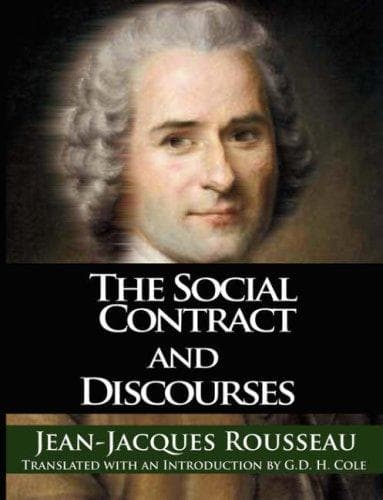
The social contract & discoursesRousseau, Jean-Jacques
Philosophy
The social contract & discourses
Rousseau, Jean-Jacques
Economics; Political science -- Early works to 1800; Social contract
The word Economy, or Œconomy, is derived from _οἰκός, a house_,
and _νόμος, law_, and meant originally only the wise and legitimate
government of the house for the common good of the whole family. The
meaning of the term was then extended to the government of that great
family, the State. To distinguish these two senses of the word, the
latter is called _general_ or _political_ economy, and the former
domestic or particular economy. The first only is discussed in the
present discourse.
Even if there were as close an analogy as many authors maintain between
the State and the family, it would not follow that the rules of conduct
proper for one of these societies would be also proper for the other.
They differ too much in extent to be regulated in the same manner; and
there will always be a great difference between domestic government, in
which a father can see everything for himself, and civil government,
where the chief sees hardly anything save through the eyes of others.
To put both on an equality in this respect, the talents, strength, and
all the faculties of the father would have to increase in proportion to
the size of his family, and the soul of a powerful monarch would have
to be, to that of an ordinary man, as the extent of his empire is to
that of a private person's estate.
But how could the government of the State be like that of the family,
when the basis on which they rest is so different? The father being
physically stronger than his children, his paternal authority, as long
as they need his protection, may be reasonably said to be established
by nature. But in the great family, all the members of which are
naturally equal, the political authority, being purely arbitrary as far
as its institution is concerned, can be founded only on conventions,
and the Magistrate can have no authority over the rest, except by
virtue of the laws. The duties of a father are dictated to him by
natural feelings, and in a manner that seldom allows him to neglect
them. For rulers there is no such principle, and they are really
obliged to the people only by what they themselves have promised to
do, and the people have therefore a right to require of them. Another
more important difference is that since the children have nothing but
what they receive from their father, it is plain that all the rights
of property belong to him, or emanate from him; but quite the opposite
is the case in the great family, where the general administration is
established only to secure individual property, which is antecedent to
it. The principal object of the work of the whole house is to preserve
and increase the patrimony of the father, in order that he may be able
some day to distribute it among his children without impoverishing
them; whereas the wealth of the exchequer is only a means, often ill
understood, of keeping the individuals in peace and plenty. In a word,
the little family is destined to be extinguished, and to resolve itself
Public-domain text, read in full here on John Shaqi.
Reviews
Reviews
No reviews yet
Be the first to share your thoughts on this work.
Elsewhere in the archive
Join the Discussion
Join the discussion
Sign in to leave a comment or review.
Sign InorCreate an account