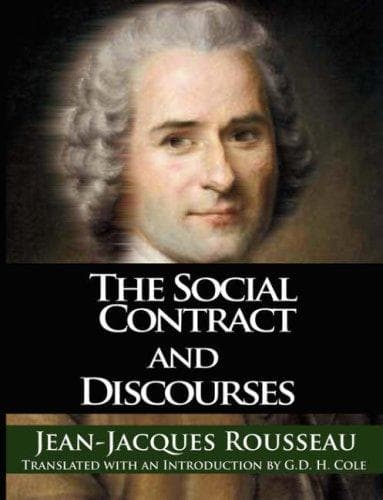
The social contract & discoursesRousseau, Jean-Jacques
Philosophy
The social contract & discourses
Rousseau, Jean-Jacques
Economics; Political science -- Early works to 1800; Social contract
some day into several families of a similar nature; but the great
family, being constituted to endure for ever in the same condition,
need not, like the small one, increase for the purpose of multiplying,
but need only maintain itself; and it can easily be proved that any
increase does it more harm than good.
In the family, it is clear, for several reasons which lie in its very
nature, that the father ought to command. In the first place, the
authority ought not to be equally divided between father and mother;
the government must be single, and in every division of opinion there
must be one preponderant voice to decide. Secondly, however lightly
we may regard the disadvantages peculiar to women, yet, as they
necessarily occasion intervals of inaction, this is a sufficient reason
for excluding them from this supreme authority: for when the balance
is perfectly even, a straw is enough to turn the scale. Besides, the
husband ought to be able to superintend his wife's conduct, because
it is of importance for him to be assured that the children, whom he
is obliged to acknowledge and maintain, belong to no-one but himself.
Thirdly, children should be obedient to their father, at first of
necessity, and afterwards from gratitude: after having had their
wants satisfied by him during one half of their lives, they ought to
consecrate the other half to providing for his. Fourthly, servants owe
him their services in exchange for the provision he makes for them,
though they may break off the bargain as soon as it ceases to suit
them. I say nothing here of slavery, because it is contrary to nature,
and cannot be authorised by any right or law.
There is nothing of all this in political society, in which the chief
is so far from having any natural interest in the happiness of the
individuals, that it is not uncommon for him to seek his own in their
misery. If the magistracy is hereditary, a community of men is often
governed by a child. If it be elective, innumerable inconveniences
arise from such election; while in both cases all the advantages of
paternity are lost. If you have but a single ruler, you lie at the
discretion of a master who has no reason to love you: and if you have
several, you must bear at once their tyranny and their divisions. In
a word, abuses are inevitable and their consequences fatal in every
society where the public interest and the laws have no natural force,
and are perpetually attacked by personal interest and the passions of
the ruler and the members.
Public-domain text, read in full here on John Shaqi.
Reviews
Reviews
No reviews yet
Be the first to share your thoughts on this work.
Elsewhere in the archive
Join the Discussion
Join the discussion
Sign in to leave a comment or review.
Sign InorCreate an account