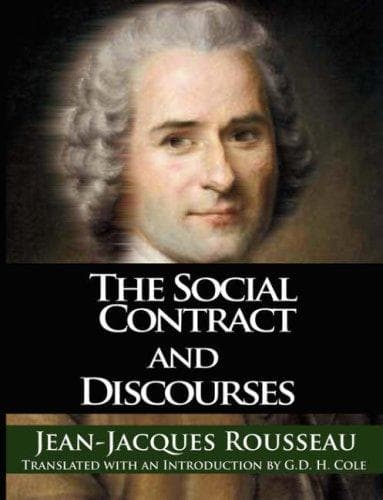
The social contract & discoursesRousseau, Jean-Jacques
Philosophy
The social contract & discourses
Rousseau, Jean-Jacques
Economics; Political science -- Early works to 1800; Social contract
The body politic, taken individually, may be considered as an
organised, living body, resembling that of man. The sovereign power
represents the head; the laws and customs are the brain, the source
of the nerves and seat of the understanding, will and senses, of
which the Judges and Magistrates are the organs: commerce, industry,
and agriculture are the mouth and stomach which prepare the common
subsistence; the public income is the blood, which a prudent _economy_,
in performing the functions of the heart, causes to distribute through
the whole body nutriment and life: the citizens are the body and the
members, which make the machine live, move and work; and no part of
this machine can be damaged without the painful impression being at
once conveyed to the brain, if the animal is in a state of health.
The life of both bodies is the self common to the whole, the reciprocal
sensibility and internal correspondence of all the parts. Where this
communication ceases, where the formal unity disappears, and the
contiguous parts belong to one another only by juxtaposition, the man
is dead, or the State is dissolved.
The body politic, therefore, is also a moral being possessed of a will;
and this general will, which tends always to the preservation and
welfare of the whole and of every part, and is the source of the laws,
constitutes for all the members of the State, in their relations to one
another and to it, the rule of what is just or unjust: a truth which
shows, by the way, how idly some writers have treated as theft the
subtlety prescribed to children at Sparta for obtaining their frugal
repasts, as if everything ordained by the law were not lawful.
It is important to observe that this rule of justice, though certain
with regard to all citizens, may be defective with regard to
foreigners. The reason is clear. The will of the State, though general
in relation to its own members, is no longer so in relation to other
States and their members, but becomes, for them, a particular and
individual will, which has its rule of justice in the law of nature.
This, however, enters equally into the principle here laid down;
for in such a case, the great city of the world becomes the body
politic, whose general will is always the law of nature, and of which
the different States and peoples are individual members. From these
distinctions, applied to each political society and its members, are
derived the most certain and universal rules, by which we can judge
whether a government is good or bad, and in general of the morality of
all human actions.
Public-domain text, read in full here on John Shaqi.
Reviews
Reviews
No reviews yet
Be the first to share your thoughts on this work.
Elsewhere in the archive
Join the Discussion
Join the discussion
Sign in to leave a comment or review.
Sign InorCreate an account