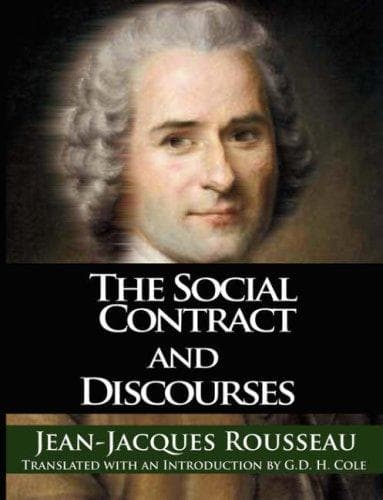
The social contract & discoursesRousseau, Jean-Jacques
Philosophy
The social contract & discourses
Rousseau, Jean-Jacques
Economics; Political science -- Early works to 1800; Social contract
Although the functions of the father of a family and those of the
chief magistrate ought to make for the same object, they must do so
in such different ways, and their duty and rights are so essentially
distinct, that we cannot confound them without forming very false ideas
about the fundamental laws of society, and falling into errors which
are fatal to mankind. In fact, if the voice of nature is the best
counsellor to which a father can listen in the discharge of his duty,
for the Magistrate it is a false guide, which continually prevents him
from performing his, and leads him on sooner or later to the ruin of
himself and of the State, if he is not restrained by the most sublime
virtue. The only precaution necessary for the father of a family is to
guard himself against depravity, and prevent his natural inclinations
from being corrupted; whereas it is these themselves which corrupt the
Magistrate. In order to act aright, the first has only to consult his
heart; the other becomes a traitor the moment he listens to his. Even
his own reason should be suspect to him, nor should he follow any rule
other than the public reason, which is the law. Thus nature has made
a multitude of good fathers of families; but it is doubtful whether,
from the very beginning of the world, human wisdom has made ten men
capable of governing their peers.
From all that has just been said, it follows that _public_ economy,
which is my subject, has been rightly distinguished from _private_
economy, and that, the State having nothing in common with the family
except the obligations which their heads lie under of making both
of them happy, the same rules of conduct cannot apply to both. I
have considered these few lines enough to overthrow the detestable
system which Sir Robert Filmer has endeavoured to establish in his
_Patriarcha_; a work to which two celebrated writers have done too much
honour in writing books to refute it. Moreover, this error is of very
long standing; for Aristotle himself thought proper to combat it with
arguments which may be found in the first book of his _Politics_.
I must here ask my readers to distinguish also between _public
economy_, which is my subject and which I call _government_, and the
supreme authority, which I call _Sovereignty_; a distinction which
consists in the fact that the latter has the right of legislation, and
in certain cases binds the body of the nation itself, while the former
has only the right of execution, and is binding only on individuals.
I shall take the liberty of making use of a very common, and in some
respects inaccurate, comparison, which will serve to illustrate my
meaning.
Public-domain text, read in full here on John Shaqi.
Reviews
Reviews
No reviews yet
Be the first to share your thoughts on this work.
Elsewhere in the archive
Join the Discussion
Join the discussion
Sign in to leave a comment or review.
Sign InorCreate an account