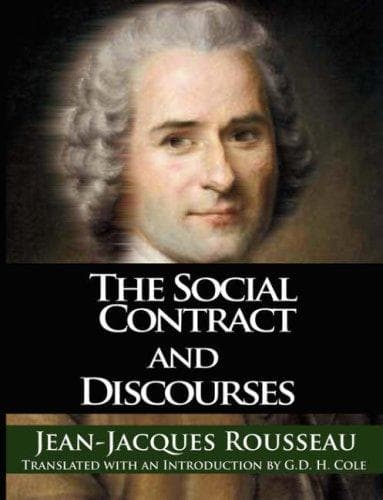
The social contract & discoursesRousseau, Jean-Jacques
Philosophy
The social contract & discourses
Rousseau, Jean-Jacques
Economics; Political science -- Early works to 1800; Social contract
If our politicians were less blinded by their ambition, they would
see how impossible it is for any establishment whatever to act in
the spirit of its institution, unless it is guided in accordance
with the law of duty; they would feel that the greatest support of
public authority lies in the hearts of the citizens, and that nothing
can take the place of morality in the maintenance of government. It
is not only upright men who know how to administer the laws; but at
bottom only good men know how to obey them. The man who once gets the
better of remorse, will not shrink before punishments which are less
severe, and less lasting, and from which there is at least the hope
of escaping: whatever precautions are taken, those who only require
impunity in order to do wrong will not fail to find means of eluding
the law, and avoiding its penalties. In this case, as all particular
interests unite against the general interest, which is no longer that
of any individual, public vices have a greater effect in enervating
the laws than the laws in the repression of such vices: so that the
corruption of the people and of their rulers will at length extend to
the government, however wise it may be. The worst of all abuses is
to pay an apparent obedience to the laws, only in order actually to
break them with security. For in this case the best laws soon become
the most pernicious; and it would be a hundred times better that
they should not exist. In such a situation, it is vain to add edicts
to edicts and regulations to regulations. Everything serves only to
introduce new abuses, without correcting the old. The more laws are
multiplied, the more they are despised, and all the new officials
appointed to supervise them are only so many more people to break
them, and either to share the plunder with their predecessors, or to
plunder apart on their own. The reward of virtue soon becomes that of
robbery; the vilest of men rise to the greatest credit; the greater
they are the more despicable they become; their infamy appears even in
their dignities, and their very honours dishonour them. If they buy
the influence of the leaders or the protection of women, it is only
that they may sell justice, duty, and the State in their turn: in the
meantime, the people, feeling that its vices are not the first cause of
its misfortunes, murmurs and complains that all its misfortunes come
solely from those whom it pays to protect it from such things.
Public-domain text, read in full here on John Shaqi.
Reviews
Reviews
No reviews yet
Be the first to share your thoughts on this work.
Elsewhere in the archive
Join the Discussion
Join the discussion
Sign in to leave a comment or review.
Sign InorCreate an account