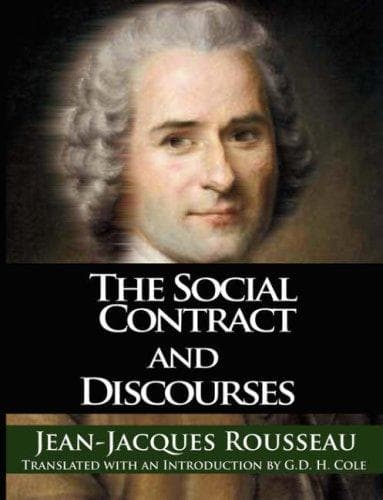
The social contract & discoursesRousseau, Jean-Jacques
Philosophy
The social contract & discourses
Rousseau, Jean-Jacques
Economics; Political science -- Early works to 1800; Social contract
It is under these circumstances that the voice of duty no longer speaks
in men's hearts, and their rulers are obliged to substitute the cry of
terror, or the lure of an apparent interest, of which they subsequently
trick their creatures. In this situation they are compelled to have
recourse to all the petty and despicable shifts which they call _rules
of State_ and _mysteries of the cabinet_. All the vigour that is left
in the government is used by its members in ruining and supplanting one
another, while the public business is neglected, or is transacted only
as personal interest requires and directs. In short, the whole art of
those great politicians lies in so mesmerising those they stand in need
of, that each may think he is labouring for his own interest in working
for theirs: I say _theirs_ on the false supposition that it is the real
interest of rulers to annihilate a people in order to make it subject,
and to; ruin their own property in order to secure their possession of
it.
But when the citizens love their duty, and the guardians of the public
authority sincerely apply themselves to the fostering of that love
by their own example and assiduity, every difficulty vanishes; and
government becomes so easy that it needs none of that art of darkness,
whose blackness is its only mystery. Those enterprising spirits,
so dangerous and so much admired, all those great ministers, whose
glory is inseparable from the miseries of the people, are no longer
regretted: public morality supplies what is wanting in the genius of
the rulers; and the more virtue reigns, the less need there is for
talent. Even ambition is better served by duty than by usurpation:
when the people is convinced that its rulers are labouring only for
its happiness, its deference saves them the trouble of labouring to
strengthen their power: and history shows us, in a thousand cases,
that the authority of one who is beloved over those whom he loves is
a hundred times more absolute than all the tyranny of usurpers. This
does not mean that the government ought to be afraid to make use of its
power, but that it ought to make use of it only in a lawful manner.
We find in history a thousand examples of pusillanimous or ambitious
rulers, who were ruined by their slackness or their pride; not one who
suffered for having been strictly just. But we ought not to confound
negligence with moderation, or clemency with weakness. To be just, it
is necessary to be severe; to permit vice, when one has the right and
the power to suppress it, is to be oneself vicious.
Public-domain text, read in full here on John Shaqi.
Reviews
Reviews
No reviews yet
Be the first to share your thoughts on this work.
Elsewhere in the archive
Join the Discussion
Join the discussion
Sign in to leave a comment or review.
Sign InorCreate an account