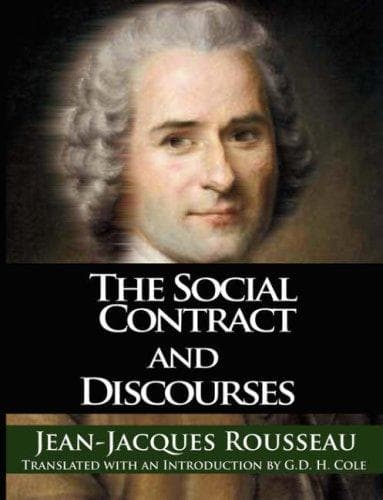
The social contract & discoursesRousseau, Jean-Jacques
Philosophy
The social contract & discourses
Rousseau, Jean-Jacques
Economics; Political science -- Early works to 1800; Social contract
which to prefer: for no people has ever been made into a nation of
philosophers, but it is not impossible to make a people happy.
Do we wish men to be virtuous? Then let us begin by making them love
their country: but how can they love it, if their country be nothing
more to them than to strangers, and afford them nothing but what it
can refuse nobody? It would be still worse, if they did not enjoy even
the privilege of social security, and if their lives, liberties and
property lay at the mercy of persons in power, without their being
permitted, or it being possible for them, to get relief from the laws.
For in that case, being subjected to the duties of the state of civil
society, without enjoying even the common privileges of the state of
nature, and without being able to use their strength in their own
defence, they would be in the worst, condition in which freemen could
possibly find themselves, and the word _country_ would mean for them
something merely odious and ridiculous. It must not be imagined that a
man can break or lose an arm, without the pain being conveyed to his
head: nor is it any more credible that the general will should consent
that any one member of the State, whoever he might be, should wound or
destroy another, than it is that the fingers of a man in his senses
should wilfully scratch his eyes out. The security of individuals is so
intimately connected with the public confederation that, apart from the
regard that must be paid to human weakness, that convention would in
point of right be dissolved, if in the State a single citizen who might
have been relieved were allowed to perish, or if one were wrongfully
confined in prison, or if in one case an obviously unjust sentence were
given. For the fundamental conventions being broken, it is impossible
to conceive of any right or interest that could retain the people in
the social union; unless they were restrained by force, which alone
causes the dissolution of the state of civil society.
Public-domain text, read in full here on John Shaqi.
Reviews
Reviews
No reviews yet
Be the first to share your thoughts on this work.
Elsewhere in the archive
Join the Discussion
Join the discussion
Sign in to leave a comment or review.
Sign InorCreate an account