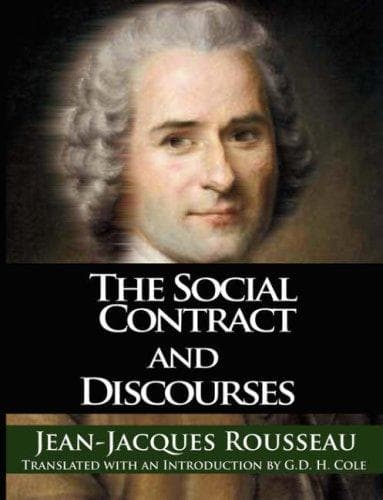
The social contract & discoursesRousseau, Jean-Jacques
Philosophy
The social contract & discourses
Rousseau, Jean-Jacques
Economics; Political science -- Early works to 1800; Social contract
It is not enough to say to the citizens, _be good_; they must be
taught to be so; and even example, which is in this respect the first
lesson, is not the sole means to be employed; patriotism is the most
efficacious: for, as I have said already, every man is virtuous when
his particular will is in all things conformable to the general will,
and we voluntarily will what is willed by those whom we love. It
appears that the feeling of humanity evaporates and grows feeble in
embracing all mankind, and that we cannot be affected by the calamities
of Tartary or Japan, in the same manner as we are by those of European
nations. It is necessary in some degree to confine and limit our
interest and compassion in order to make it active. Now, as this
sentiment can be useful only to those with whom we have to live, it is
proper that our humanity should confine itself to our fellow-citizens,
and should receive a new force because we are in the habit of seeing
them, and by reason of the common interest which unites them. It is
certain that the greatest miracles of virtue have been produced by
patriotism: this fine and lively feeling, which gives to the force of
self-love all the beauty of virtue, lends it an energy which, without
disfiguring it, makes it the most heroic of all passions. This it is
that produces so many immortal actions, the glory of which dazzles our
feeble eyes; and so many great men, whose old-world virtues pass for
fables now that patriotism is made mock of. This is not surprising;
the transports of susceptible hearts appear altogether fanciful to any
one who has never felt them; and the love of one's country, which is a
hundred times more lively and delightful than the love of a mistress,
cannot be conceived except by experiencing it. But it is easy to
perceive in every heart that is warmed by it, in all the actions it
inspires, a glowing and sublime ardour which does not attend the purest
virtue, when separated from it. Contrast Socrates even with Cato; the
one was the greater philosopher, the other more of the citizen. Athens
was already ruined in the time of Socrates, and he had no other country
than the world at large. Cato had the cause of his country always at
heart; he lived for it alone, and could not bear to outlive it. The
virtue of Socrates was that of the wisest of men; but, compared with
Cæsar and Pompey, Cato seems a God among mortals. Socrates instructed
a few individuals, opposed the Sophists, and died for truth: but Cato
defended his country, its liberty and its laws, against the conquerors
of the world, and at length departed from the earth, when he had no
longer a country to serve. A worthy pupil of Socrates would be the most
virtuous of his contemporaries; but a worthy follower of Cato would be
one of the greatest. The virtue of the former would be his happiness;
the latter would seek his happiness in that of all. We should be taught
by the one, and led by the other; and this alone is enough to determine
Public-domain text, read in full here on John Shaqi.
Reviews
Reviews
No reviews yet
Be the first to share your thoughts on this work.
Elsewhere in the archive
Join the Discussion
Join the discussion
Sign in to leave a comment or review.
Sign InorCreate an account