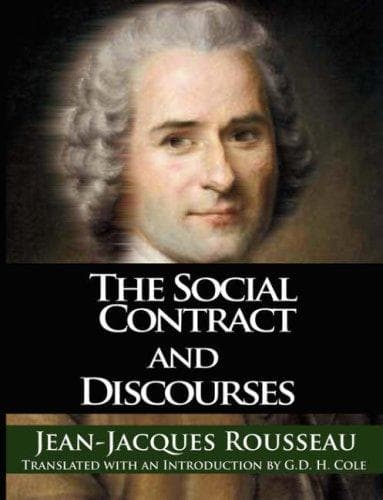
The social contract & discoursesRousseau, Jean-Jacques
Philosophy
The social contract & discourses
Rousseau, Jean-Jacques
Economics; Political science -- Early works to 1800; Social contract
In Macedon, the life of a man was a matter of such importance, that
Alexander the Great, at the height of his glory, would not have dared
to put a Macedonian criminal to death in cold blood, till the accused
had appeared to make his defence before his fellow-citizens, and had
been condemned by them. But the Romans distinguished themselves above
all other peoples by the regard which their government paid to the
individual, and by its scrupulous attention to the preservation of
the inviolable rights of all the members of the State. Nothing was
so sacred among them as the life of a citizen; and no less than an
assembly of the whole people was needed to condemn one. Not even the
Senate, nor the Consuls, in all their majesty, possessed the right;
but the crime and punishment of a citizen were regarded as a public
calamity among the most powerful people in the world. So hard indeed
did it seem to shed blood for any crime whatsoever, that by the Lex
Porcia, the penalty of death was commuted into that of banishment for
all those who were willing to survive the loss of so great a country.
Everything both at Rome, and in the Roman armies, breathed that love of
fellow-citizens one for another, and that respect for the Roman name,
which raised the courage and inspired the virtue of every one who had
the honour to bear it. The cap of a citizen delivered from slavery,
the civic crown of him who had saved the life of another, were looked
upon with the greatest pleasure amid the pomp of their triumphs; and
it is remarkable that among the crowns which were bestowed in honour
of splendid actions in war, the civic crown and that of the triumphant
general alone were of laurel, all the others being merely of gold. It
was thus that Rome was virtuous and became the mistress of the world.
Ambitious rulers! A herdsman governs his dogs and cattle, and yet is
only the meanest of mankind. If it be a fine thing to command, it is
when those who obey us are capable of doing us honour. Show respect,
therefore, to your fellow-citizens, and you will render yourselves
worthy of respect; show respect to liberty, and your power will
increase daily. Never exceed your rights, and they will soon become
unlimited.
Public-domain text, read in full here on John Shaqi.
Reviews
Reviews
No reviews yet
Be the first to share your thoughts on this work.
Elsewhere in the archive
Join the Discussion
Join the discussion
Sign in to leave a comment or review.
Sign InorCreate an account