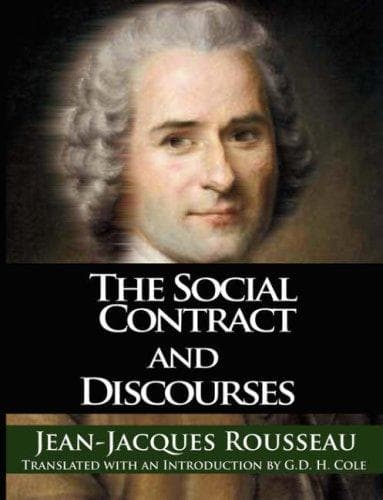
The social contract & discoursesRousseau, Jean-Jacques
Philosophy
The social contract & discourses
Rousseau, Jean-Jacques
Economics; Political science -- Early works to 1800; Social contract
I shall say nothing of the Magistrates destined to preside over such
an education, which is certainly the most important business of the
State. It is easy to see that if such marks of public confidence
were conferred on slight grounds, if this sublime function were not,
for those who have worthily discharged all other offices, the reward
of labour, the pleasant and honourable repose of old age, and the
crown of all honours, the whole enterprise would be useless and the
education void of success. For where-ever the lesson is not supported
by authority, and the precept by example, all instruction is fruitless;
and virtue itself loses its credit in the mouth of one who does not
practise it. But let illustrious warriors, bent under the weight of
their laurels, preach courage: let upright Magistrates, grown white
in the purple and on the bench teach justice. Such teachers as these
would thus get themselves virtuous successors, and transmit from age to
age, to generations to come, the experience and talents of rulers, the
courage and virtue of citizens, and common emulation in all to live and
die for their country.
I know of but three peoples which once practised public education, the
Cretans, the Lacedæmonians, and the ancient Persians: among all these
it was attended with the greatest success, and indeed it did wonders
among the two last. Since the world has been divided into nations too
great to admit of being well governed, this method has been no longer
practicable, and the reader will readily perceive other reasons why
such a thing has never been attempted by any modern people. It is very
remarkable that the Romans were able to dispense with it; but Rome was
for five hundred years one continued miracle which the world cannot
hope to see again. The virtue of the Romans, engendered by their horror
of tyranny and the crimes of tyrants, and by an innate patriotism, made
all their houses so many schools of citizenship; while the unlimited
power of fathers over their children made the individual authority so
rigid that the father was more feared than the Magistrate, and was in
his family tribunal both censor of morals and avenger of the laws.
Thus a careful and well-intentioned government, vigilant incessantly to
maintain or restore patriotism and morality among the people, provides
beforehand against the evils which sooner or later result from the
indifference of the citizens to the fate of the Republic, keeping
within narrow bounds that personal interest which so isolates the
individual that the State is enfeebled by his power, and has nothing
to hope from his good-will. Wherever men love their country, respect
the laws, and live simply, little remains to be done in order to make
them happy; and in public administration, where chance has less
influence than in the lot of individuals, wisdom is so nearly allied to
happiness, that the two objects are confounded.
Public-domain text, read in full here on John Shaqi.
Reviews
Reviews
No reviews yet
Be the first to share your thoughts on this work.
Elsewhere in the archive
Join the Discussion
Join the discussion
Sign in to leave a comment or review.
Sign InorCreate an account