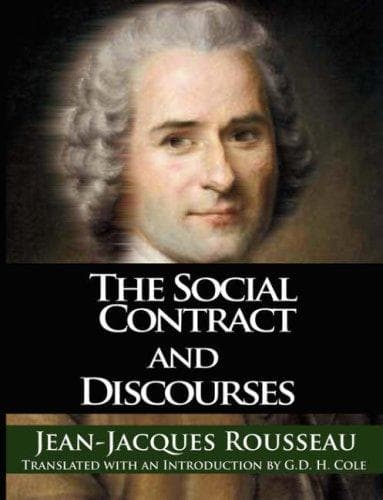
The social contract & discoursesRousseau, Jean-Jacques
Philosophy
The social contract & discourses
Rousseau, Jean-Jacques
Economics; Political science -- Early works to 1800; Social contract
III. It is not enough to have citizens and to protect them, it is also
necessary to consider their subsistence. Provision for the public wants
is an obvious inference from the general will, and the third essential
duty of government. This duty is not, we should feel, to fill the
granaries of individuals and thereby to grant them a dispensation from
labour, but to keep plenty so within their reach that labour is always
necessary and never useless for its acquisition. It extends also to
everything regarding the management of the exchequer, and the expenses
of public administration. Having thus treated of general economy with
reference to the government of persons, we must now consider it with
reference to the administration of property.
This part presents no fewer difficulties to solve, and contradictions
to remove, than the preceding. It is certain that the right of property
is the most sacred of all the rights of citizenship, and even more
important in some respects than liberty itself; either because it more
nearly affects the preservation of life, or because, property being
more easily usurped and more difficult to defend than life, the law
ought to pay a greater attention to what is most easily taken away; or
finally, because property is the true foundation of civil society, and
the real guarantee of the undertakings of citizens: for if property
were not answerable for personal actions, nothing would be easier
than to evade duties and laugh at the laws. On the other hand, it is
no less certain that the maintenance of the State and the government
involves costs and out-goings; and as every one who agrees to the end
must acquiesce in the means, it follows that the members of a society
ought to contribute from their property to its support. Besides, it is
difficult to secure the property of individuals on one side, without
attacking it on another; and it is impossible that all the regulations
which govern the order of succession, will, contracts, &c. should not
lay individuals under some constraint as to the disposition of their
goods, and should not consequently restrict the right of property.
But besides what I have said above of the agreement between the
authority of law and the liberty of the citizen, there remains to
be made, with respect to the disposition of goods, an important
observation which removes many difficulties. As Puffendorf has shown,
the right of property, by its very nature, does not extend beyond the
life of the proprietor, and the moment a man is dead his goods cease
to belong to him. Thus, to prescribe the conditions according to which
he can dispose of them, is in reality less to alter his right as it
appears, than to extend it in fact.
Public-domain text, read in full here on John Shaqi.
Reviews
Reviews
No reviews yet
Be the first to share your thoughts on this work.
Elsewhere in the archive
Join the Discussion
Join the discussion
Sign in to leave a comment or review.
Sign InorCreate an account