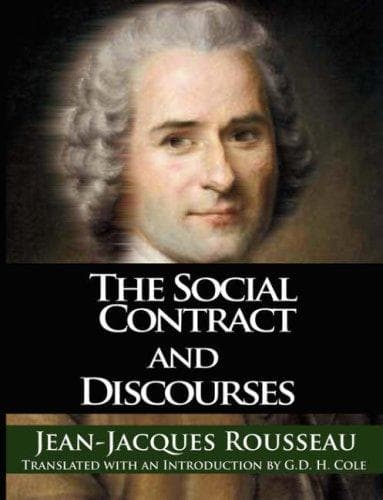
The social contract & discoursesRousseau, Jean-Jacques
Philosophy
The social contract & discourses
Rousseau, Jean-Jacques
Economics; Political science -- Early works to 1800; Social contract
despising the laws that protected them, as well as their fellows whose
bread they ate, imagined themselves more honoured in being Cæsar's
satellites than in being defenders of Rome. As they were given over
to blind obedience, their swords were always at the throats of their
fellow-citizens, and they were prepared for general butchery at the
first sign. It would not be difficult to show that this was one of the
principal causes of the ruin of the Roman Empire.
The invention of artillery and fortifications has forced the princes
of Europe, in modern times, to return to the use of regular troops, in
order to garrison their towns; but> however lawful their motives, it is
to be feared the effect may be no less fatal. There is no better reason
now than formerly for depopulating the country to form armies and
garrisons, nor should the people be oppressed to support, them; in a
word, these dangerous establishments have increased of late years with
such rapidity in this part of the world, that they evidently threaten
to depopulate Europe, and sooner or later to ruin its inhabitants.
Be this as it may, it ought to be seen that such institutions
necessarily subvert the true economic system, which draws the principal
revenue of the State from the public demesne, and leave only the
troublesome resource of subsidies and imposts; with which it remains to
deal.
It should be remembered that the foundation of the social compact is
property; and its first condition, that every one should be maintained
in the peaceful possession of what belongs to him. It is true that,
by the same treaty, every one binds himself, at least tacitly, to
be assessed toward the public wants: but as this undertaking cannot
prejudice the fundamental law, and presupposes that the need is
clearly recognised by all who contribute to it, it is plain that such
assessment, in order to be lawful, must be voluntary; it must depend,
not indeed on a particular will, as if it were necessary to have the
consent of each individual, and that he should give no more than just
what he pleased, but on a general will, decided by vote of a majority,
and on the basis of a proportional rating which leaves nothing
arbitrary in the imposition of the tax.
Public-domain text, read in full here on John Shaqi.
Reviews
Reviews
No reviews yet
Be the first to share your thoughts on this work.
Elsewhere in the archive
Join the Discussion
Join the discussion
Sign in to leave a comment or review.
Sign InorCreate an account