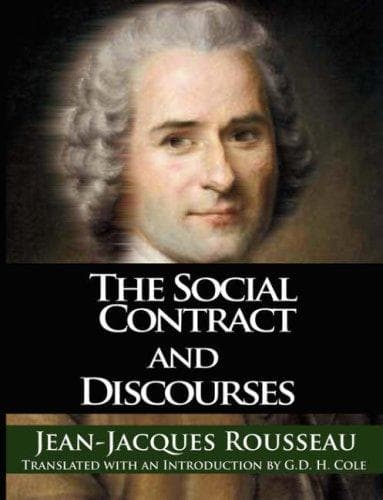
The social contract & discoursesRousseau, Jean-Jacques
Philosophy
The social contract & discourses
Rousseau, Jean-Jacques
Economics; Political science -- Early works to 1800; Social contract
A desire for conquest is one of the most evident and dangerous causes
of this increase. This desire, occasioned often by a different species
of ambition from that which, it seems to proclaim, is not always
what it appears to be, and has not so much, for its real motive, the
apparent desire to aggrandise the Nation as a secret desire to increase
the authority of the rulers at home, by increasing the number of
troops, and by the diversion which the objects of war occasion in the
minds of the citizens.
It is at least certain, that no peoples are so oppressed and wretched
as conquering nations, and that their successes only increase their
misery. Did not history inform us of the fact, reason would suffice
to tell us that, the greater a State grows, the heavier and more
burdensome in proportion its expenses become: for every province has
to furnish its share to the general expense of government, and besides
has to be at the expense of its own administration, which is as great
as if it were really independent. Add to this that great fortunes are
always acquired in one place and spent in another. Production therefore
soon ceases to balance consumption, and a whole country is impoverished
merely to enrich a single town.
Another source of the increase of public wants, which depends on the
foregoing, is this. There may come a time when the citizens, no longer
looking upon themselves as interested in the common cause, will cease
to be the defenders of their country, and the Magistrates will prefer
the command of mercenaries to that of free-men; if for no other reason
than that, when the time comes, they may use them to reduce free-men to
submission. Such was the state of Rome towards the end of the Republic
and under the Emperors: for all the victories of the early Romans,
like those of Alexander, had been won by brave citizens, who were
ready, at need, to give their blood in the service of their country,
but would never sell it. Only at the siege of Veii did the practice
of paying the Roman infantry begin. Marius, in the Jugurthine war,
dishonoured the legions by introducing freedmen, vagabonds and other
mercenaries. Tyrants, the enemies of the very people it was their duty
to make happy, maintained regular troops, apparently to withstand
the foreigner, but really to enslave their countrymen. To form such
troops, it was necessary to take men from the land; the lack of their
labour then diminished the amount of provisions, and their maintenance
introduced those taxes which increased prices. This first disorder
gave rise to murmurs among the people; in order to suppress them, the
number of troops had to be increased, and consequently the misery
of the people also got worse; and the growing despair led to still
further increases in the cause in order to guard against its effects.
On the other hand, the mercenaries, whose merit we may judge of by the
price at which they sold themselves, proud of their own meanness, and
Public-domain text, read in full here on John Shaqi.
Reviews
Reviews
No reviews yet
Be the first to share your thoughts on this work.
Elsewhere in the archive
Join the Discussion
Join the discussion
Sign in to leave a comment or review.
Sign InorCreate an account