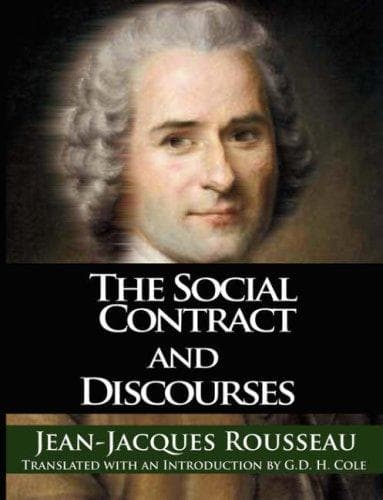
The social contract & discoursesRousseau, Jean-Jacques
Philosophy
The social contract & discourses
Rousseau, Jean-Jacques
Economics; Political science -- Early works to 1800; Social contract
"The problem is to find a form of association which will defend and
protect with the whole common force the person and goods of each
associate, and in which each, while uniting himself with all, may still
obey himself alone, and remain as free as before." "The clauses of the
contract ... are everywhere the same and everywhere tacitly admitted
and recognised.... These clauses, properly understood, may be reduced
to one--the total alienation of each associate, together with all his
rights, to the whole community...; for, if the individuals retained
certain rights, as there would be no common superior to decide between
them and the public, each, being on one point his own judge, would ask
to be so on all, and the state of nature would continue" (Book I, chap.
vi). Rousseau sees clearly that it is impossible to place any limits
upon the power of the State; when the people combine into a State, they
must in the end submit to be guided in all things by the will of the
effective majority. Limited Sovereignty is a contradiction in terms;
the Sovereign has a right to all that reason allows it, and as soon as
reason demands that the State shall interfere, no appeal to individual
rights can be made. What is best for the State must be suffered by the
individual. This, however, is very far from meaning that the ruling
power ought, or has the moral right, to interfere in every particular
case. Rousseau has been subjected to much foolish criticism because,
after upholding the State's absolute supremacy, he goes on (Book II,
chap, iv) to speak of "the limits of the sovereign power." There is no
contradiction whatsoever. Wherever State intervention is for the best,
the State has a right to intervene; but it has no moral right, though
it must have a legal right, to intervene where it is not for the best.
The General Will, being always in the right, will intervene only when
intervention is proper. "The Sovereign," therefore, "cannot impose upon
its subjects any fetters that are useless to the community, nor can
it even wish to do so." As, however, the infallibility of the General
Will is not enough to make the State infallible, there still remains
an objection. Since the General Will cannot always be arrived at, who
is to judge whether an act of intervention is justified? Rousseau's
answer fails to satisfy many of his critics. "Each man alienates, I
admit, by the social compact, only such part of his powers, goods and
liberty as it is important for the community to control; but it must
also be granted that the Sovereign is sole judge of what is important."
This, we are told, is mere State tyranny over again. But how is it
possible to avoid such a conclusion? Rousseau has already given his
reasons for objecting to a limited Sovereignty (Book I, chap, vi): it
follows absolutely that we must take the best machinery we can find for
the execution of the State's functions. No doubt the machinery will
be imperfect; but we can only try to get as near the General Will as
Public-domain text, read in full here on John Shaqi.
Reviews
Reviews
No reviews yet
Be the first to share your thoughts on this work.
Join the Discussion
Join the discussion
Sign in to leave a comment or review.
Sign InorCreate an account