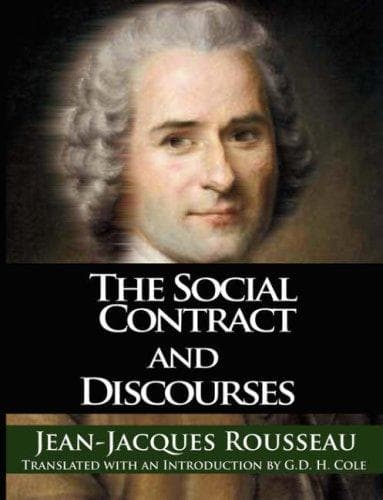
The social contract & discoursesRousseau, Jean-Jacques
Philosophy
The social contract & discourses
Rousseau, Jean-Jacques
Economics; Political science -- Early works to 1800; Social contract
Aristotle was right; but he took the effect for the cause. Nothing
can be more certain than that every man born in slavery is born for
slavery. Slaves lose everything in their chains, even the desire of
escaping from them: they love their servitude, as the comrades of
Ulysses loved their brutish condition.[2] If then there are slaves by
nature, it is because there have been slaves against nature. Force made
the first slaves, and their cowardice perpetuated the condition.
I have said nothing of King Adam, or Emperor Noah, father of the three
great monarchs who shared out the universe, like the children of
Saturn, whom some scholars have recognised in them. I trust to getting
due thanks for my moderation; for, being a direct descendant of one
of these princes, perhaps of the eldest branch, how do I know that a
verification of titles might not leave me the legitimate king of the
human race? In any case, there can be no doubt that Adam was sovereign
of the world, as Robinson Crusoe was of his island, as long as he
was its only inhabitant; and this empire had the advantage that the
monarch, safe on his throne, had no rebellions, wars, or conspirators
to fear.
[1] "Learned inquiries into public right are often only the history of
past abuses; and troubling to study them too deeply is a profitless
infatuation" (_Essay on the Interests of France in Relation to its
Neighbours_, by the Marquis d'Argenson). This is exactly what Grotius
has done.
[2] See a short treatise of Plutarch's entitled "That Animals Reason."
CHAPTER III
THE RIGHT OF THE STRONGEST
The strongest is never strong enough to be always the master, unless
he transforms strength into right, and obedience into duty. Hence the
right of the strongest, which, though to all seeming meant ironically,
is really laid down as a fundamental principle. But are we never to
have an explanation of this phrase? Force is a physical power, and I
fail to see what moral effect it can have. To yield to force is an act
of necessity, not of will--at the most, an act of prudence. In what
sense can it be a duty?
Suppose for a moment that this so-called "right" exists. I maintain
that the sole result is a mass of inexplicable nonsense. For, if force
creates right, the effect changes with the cause: every force that
is greater than the first succeeds to its right. As soon as it is
possible to disobey with impunity, disobedience is legitimate; and, the
strongest being always in the right, the only thing that matters is
to act so as to become the strongest. But what kind of right is that
which perishes when force fails? If we must obey perforce, there is no
need to obey because we ought; and if we are not forced to obey, we are
under no obligation to do so. Clearly, the word "right" adds nothing to
force: in this connection, it means absolutely nothing.
Public-domain text, read in full here on John Shaqi.
Reviews
Reviews
No reviews yet
Be the first to share your thoughts on this work.
Join the Discussion
Join the discussion
Sign in to leave a comment or review.
Sign InorCreate an account