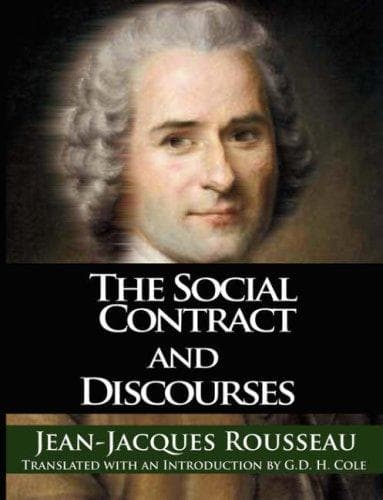
The social contract & discoursesRousseau, Jean-Jacques
Philosophy
The social contract & discourses
Rousseau, Jean-Jacques
Economics; Political science -- Early works to 1800; Social contract
Even if each man could alienate himself, he could not alienate his
children: they are born men and free; their liberty belongs to them,
and no one but they has the right to dispose of it. Before they come to
years of discretion, the father can, in their name, lay down conditions
for their preservation and well-being, but he cannot give them,
irrevocably and without conditions: such a gift is contrary to the ends
of nature, and exceeds the rights of paternity. It would therefore be
necessary, in order to legitimise an arbitrary government, that in
every generation the people should be in a position to accept or reject
it; but, were this so, the government would be no longer arbitrary.
To renounce liberty is to renounce being a man, to surrender the rights
of humanity and even its duties. For him who renounces everything no
indemnity is possible. Such a renunciation is incompatible with man's
nature; to remove all liberty from his will is to remove all morality
from his acts. Finally, it is an empty and contradictory convention
that sets up, on the one side, absolute authority, and, on the other,
unlimited obedience. Is it not clear that we can be under no obligation
to a person from whom we have the right to exact everything? Does not
this condition alone, in the absence of equivalence or exchange, in
itself involve the nullity of the act? For what right can my slave have
against me, when all that he has belongs to me, and, his right being
mine, this right of mine against myself is a phrase devoid of meaning?
Grotius and the rest find in war another origin for the so-called right
of slavery. The victor having, as they hold, the right of killing
the vanquished, the latter can buy back his life at the price of his
liberty; and this convention is the more legitimate because it is to
the advantage of both parties.
But it is clear that this supposed right to kill the conquered is by no
means deducible from the state of war. Men, from the mere fact that,
while they are living in their primitive independence, they have no
mutual relations stable enough to constitute either the state of peace
or the state of war, cannot be naturally enemies. War is constituted by
a relation between things, and not between persons; and, as the state
of war cannot arise out of simple personal relations, but only out of
real relations, private war, or war of man with man, can exist neither
in the state of nature, where there is no constant property, nor in the
social state, where everything is under the authority of the laws.
Individual combats, duels and encounters, are acts which cannot
constitute a state; while the private wars, authorised by the
Establishments of Louis IX, King of France, and suspended by the Peace
of God, are abuses of feudalism, in itself an absurd system if ever
there was one, and contrary to the principles of natural right and to
all good polity.
Public-domain text, read in full here on John Shaqi.
Reviews
Reviews
No reviews yet
Be the first to share your thoughts on this work.
Join the Discussion
Join the discussion
Sign in to leave a comment or review.
Sign InorCreate an account