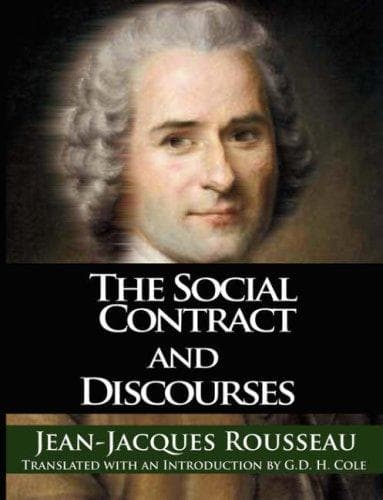
The social contract & discoursesRousseau, Jean-Jacques
Philosophy
The social contract & discourses
Rousseau, Jean-Jacques
Economics; Political science -- Early works to 1800; Social contract
In fact, each individual, as a man, may have a particular will
contrary or dissimilar to the general will which he has as a citizen.
His particular interest may speak to him quite differently from the
common interest: his absolute and naturally independent existence may
make him look upon what he owes to the common cause as a gratuitous
contribution, the loss of which will do less harm to others than the
payment of it is burdensome to himself; and, regarding the moral person
which constitutes the State as a persona ficta, because not a man, he
may wish to enjoy the rights of citizenship without being ready to
fulfil the duties of a subject. The continuance of such an injustice
could not but prove the undoing of the body politic.
In order then that the social compact may not be an empty formula, it
tacitly includes the undertaking, which alone can give force to the
rest, that whoever refuses to obey the general will shall be compelled
to do so by the whole body. This means nothing less than that he will
be forced to be free; for this is the condition which, by giving each
citizen to his country, secures him against all personal dependence. In
this lies the key to the working of the political machine; this alone
legitimizes civil undertakings, which, without it, would be absurd,
tyrannical, and liable to the most frightful abuses.
CHAPTER VIII
THE CIVIL STATE
The passage from the state of nature to the civil state produces a very
remarkable change in man, by substituting justice, for instinct in his
conduct, and giving his actions the morality they had formerly lacked.
Then only, when the voice of duty takes the place of physical impulses
and right of appetite, does _man_, who so far had considered only
himself, find that he is forced to act on different principles, and
to consult his reason before listening to his inclinations. Although,
in this state, he deprives himself of some advantages which he got
from nature, he gains in return others so great, his faculties are
so stimulated and developed, his ideas so extended, his feelings so
ennobled, and his whole soul so uplifted, that, did not the abuses of
this new condition often degrade him below that which he left, he would
be bound to bless continually the happy moment which took him from it
for ever, and, instead of a stupid and unimaginative animal, made him
an intelligent being and a man.
Public-domain text, read in full here on John Shaqi.
Reviews
Reviews
No reviews yet
Be the first to share your thoughts on this work.
Join the Discussion
Join the discussion
Sign in to leave a comment or review.
Sign InorCreate an account