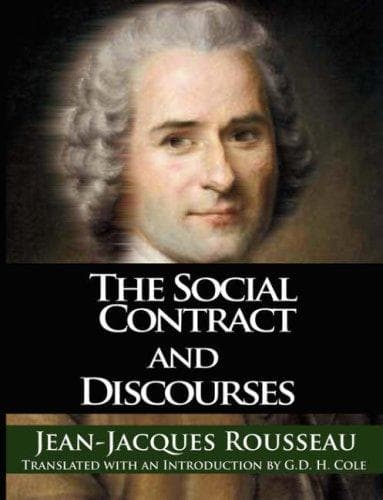
The social contract & discoursesRousseau, Jean-Jacques
Philosophy
The social contract & discourses
Rousseau, Jean-Jacques
Economics; Political science -- Early works to 1800; Social contract
Or it may restrict the government to a small number; so that there are
more private citizens than magistrates; and this is named _aristocracy_.
Lastly, it may concentrate the whole government in the hands of a
single magistrate from whom all others hold their power. This third
form is the most usual, and is called _monarchy_, or royal government.
It should be remarked that all these forms, or at least the first two,
admit of degree, and even of very wide differences; for democracy may
include the whole people, or may be restricted to half. Aristocracy, in
its turn, may be restricted indefinitely from half the people down to
the smallest possible number. Even royalty is susceptible of a measure
of distribution. Sparta always had two kings, as its constitution
provided; and the Roman Empire saw as many as eight emperors at once,
without it being possible to say that the Empire was split up. Thus
there is a point at which each form of government passes into the next,
and it becomes clear that, under three comprehensive denominations,
government is really susceptible of as many diverse forms as the State
has citizens.
There are even more: for, as the government may also, in certain
aspects, be subdivided into other parts, one administered in one
fashion and one in another, the combination of the three forms
may result in a multitude of mixed forms, each of which admits of
multiplication by all the simple forms.
There has been at all times much dispute concerning the best form of
government, without consideration of the fact that each is in some
cases the best, and in others the worst.
If, in the different States, the number of supreme magistrates should
be in inverse ratio to the number of citizens, it follows that,
generally, democratic government suits small States, aristocratic
government those of middle size, and monarchy great ones. This rule
is immediately deducible from the principle laid down. But it is
impossible to count the innumerable circumstances which may furnish
exceptions.
CHAPTER IV
DEMOCRACY
He who makes the law knows better than any one else how it should be
executed and interpreted. It seems then impossible to have a better
constitution than that in which the executive and legislative powers
are united; but this very fact renders the government in certain
respects inadequate, because things which should be distinguished are
confounded, and the prince and the Sovereign, being the same person,
form, so to speak, no more than a government without government.
Public-domain text, read in full here on John Shaqi.
Reviews
Reviews
No reviews yet
Be the first to share your thoughts on this work.
Elsewhere in the archive
Join the Discussion
Join the discussion
Sign in to leave a comment or review.
Sign InorCreate an account