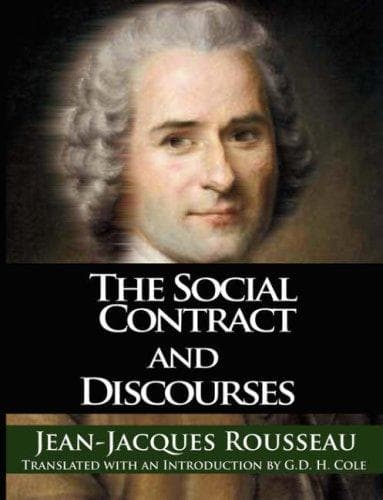
The social contract & discoursesRousseau, Jean-Jacques
Philosophy
The social contract & discourses
Rousseau, Jean-Jacques
Economics; Political science -- Early works to 1800; Social contract
It is not good for him who makes the laws to execute them, or for the
body of the people to turn its attention away from a general standpoint
and devote it to particular objects. Nothing is more dangerous than
the influence of private interests in public affairs, and the abuse of
the laws by the government is a less evil than the corruption of the
legislator, which is the inevitable sequel to a particular standpoint.
In such a case, the State being altered in substance, all reformation
becomes impossible. A people that would never misuse governmental
powers would never misuse independence; a people that would always
govern well would not need to be governed.
If we take the term in the strict sense, there never has been a real
democracy, and there never will be. It is against the natural order for
the many to govern and the few to be governed. It is unimaginable that
the people should remain continually assembled to devote their time to
public affairs, and it is clear that they cannot set up commissions for
that purpose without the form of administration being changed.
In fact, I can confidently lay down as a principle that, when the
functions of government are shared by several tribunals, the less
numerous sooner or later acquire the greatest authority, if only
because they are in a position to expedite affairs, and power thus
naturally comes into their hands.
Besides, how many conditions that are difficult to unite does such a
government presuppose! First, a very small State, where the people can
readily be got together and where each citizen can with ease know all
the rest; secondly, great simplicity of manners, to prevent business
from multiplying and raising thorny problems; next, a large measure
of equality in rank and fortune, without which equality of rights and
authority cannot long subsist; lastly, little or no luxury--for luxury
either comes of riches or makes them necessary; it corrupts at once
rich and poor, the rich by possession and the poor by covetousness; it
sells the country to softness and vanity, and takes away from the State
all its citizens, to make them slaves one to another, and one and all
to public opinion.
This is why a famous writer has made virtue the fundamental principle
of Republics; for all these conditions could not exist without virtue.
But, for want of the necessary distinctions, that great thinker was
often inexact, and sometimes obscure, and did not see that, the
sovereign authority being everywhere the same, the same principle
should be found in every well-constituted State, in a greater or less
degree, it is true, according to the form of the government.
Public-domain text, read in full here on John Shaqi.
Reviews
Reviews
No reviews yet
Be the first to share your thoughts on this work.
Elsewhere in the archive
Join the Discussion
Join the discussion
Sign in to leave a comment or review.
Sign InorCreate an account