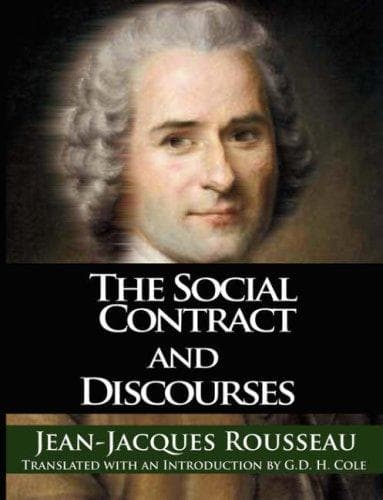
The social contract & discoursesRousseau, Jean-Jacques
Philosophy
The social contract & discourses
Rousseau, Jean-Jacques
Economics; Political science -- Early works to 1800; Social contract
For a monarchical State to have a chance of being well governed, its
population and extent must be proportionate to the abilities of its
governor. If is easier to conquer than to rule. With a long enough
lever, the world could be moved with a single finger; to sustain it
needs the shoulders of Hercules. However small a State may be, the
prince is hardly ever big enough for it. When, on the other hand,
it happens that the State is too small for its ruler, in these rare
cases too it is ill governed, because the ruler, constantly pursuing
his great designs, forgets the interests of the people, and makes
it no less wretched by misusing the talents he has, than a ruler of
less capacity would make it for want of those he had not. A kingdom
should, so to speak, expand or contract with each reign, according to
the prince's capabilities; but, the abilities of a senate being more
constant in quantity, the State can then have permanent frontiers
without the administration suffering.
The disadvantage that is most felt in monarchical government is the
want of the continuous succession which, in both the other forms,
provides an unbroken bond of union. When one king dies, another is
needed; elections leave dangerous intervals and are full of storms; and
unless the citizens are disinterested and upright to a degree which
very seldom goes with this kind of government, intrigue and corruption
abound. He to whom the State has sold itself can hardly help selling
it in his turn and repaying himself, at the expense of the weak, the
money the powerful have wrung from him. Under such an administration,
venality sooner or later spreads through every part, and peace so
enjoyed under a king is worse than the disorders of an interregnum.
What has been done to prevent these evils? Crowns have been made
hereditary in certain families, and an order of succession has been
set up, to prevent disputes from arising on the death of kings. That
is to say, the disadvantages of regency have been put in place of
those of election, apparent tranquillity has been preferred to wise
administration, and men have chosen rather to risk having children,
monstrosities, or imbeciles as rulers to having disputes over the
choice of good kings. It has not been taken into account that, in
so exposing ourselves to the risks this possibility entails, we are
setting almost all the chances against us. There was sound sense in
what the younger Dionysius said to his father, who reproached him for
doing some shameful deed by asking, "Did I set you the example?" "No,"
answered his son, "but your father was not king."
Public-domain text, read in full here on John Shaqi.
Reviews
Reviews
No reviews yet
Be the first to share your thoughts on this work.
Elsewhere in the archive
Join the Discussion
Join the discussion
Sign in to leave a comment or review.
Sign InorCreate an account