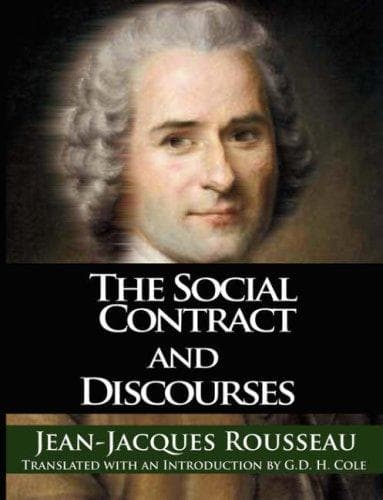
The social contract & discoursesRousseau, Jean-Jacques
Philosophy
The social contract & discourses
Rousseau, Jean-Jacques
Economics; Political science -- Early works to 1800; Social contract
These difficulties have not escaped our writers, who, all the same,
are not troubled by them. The remedy, they say, is to obey without a
murmur: God sends bad kings in His wrath, and they must be borne as
the scourges of Heaven. Such talk is doubtless edifying; but it would
be more in place in a pulpit than in a political book. What are we to
think of a doctor who promises miracles, and whose whole art is to
exhort the sufferer to patience? We know for ourselves that we must put
up with a bad government when it is there; the question is how to find
a good one.
[1] Macchiavelli was a proper man and a good citizen; but, being
attached to the court of the Medici, he could not help veiling his love
of liberty in the midst of his country's oppression. The choice of his
detestable hero, Cæsar Borgia, clearly enough shows his hidden aim;
and the contradiction between the teaching of the _Prince_ and that of
the _Discourses on Livy_ and the _History of Florence_ shows that this
profound political thinker has so far been studied only by superficial
or corrupt readers. The Court of Rome sternly prohibited his book. I
can well believe it; for it is that Court it most clearly portrays.
[2] Tacitus, _Histories_, i. 16. "For the best, and also the shortest
way of finding out what is good and what is bad is to consider what you
would have wished to happen or not to happen, had another than you been
Emperor."
[3] In the _Politicus_.
CHAPTER VII
MIXED GOVERNMENTS
Strictly speaking, there is no such thing as a simple government. An
isolated ruler must have subordinate magistrates; a popular government
must have a head. There is therefore, in the distribution of the
executive power, always a gradation from the greater to the lesser
number, with the difference that sometimes the greater number is
dependent on the smaller, and sometimes the smaller on the greater.
Sometimes the distribution is equal, when either the constituent parts
are in mutual dependence, as in the government of England, or the
authority of each section is independent, but imperfect, as in Poland.
This last form is bad; for it secures no unity in the government, and
the State is left without a bond of union.
Is a simple or a mixed government the better? Political writers are
always debating the question, which must be answered as we have already
answered a question about all forms of government.
Simple government is better in itself, just because it is simple.
But when the executive power is not sufficiently dependent upon the
legislative power, _i.e._ when the prince is more closely related to
the Sovereign than the people to the prince, this lack of proportion
must be cured by the division of the government; for all the parts have
then no less authority over the subjects, while their division makes
them all together less strong against the Sovereign.
Public-domain text, read in full here on John Shaqi.
Reviews
Reviews
No reviews yet
Be the first to share your thoughts on this work.
Elsewhere in the archive
Join the Discussion
Join the discussion
Sign in to leave a comment or review.
Sign InorCreate an account