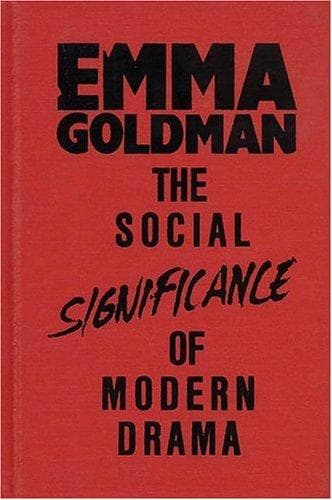
The Social Significance of the Modern DramaGoldman, Emma
History
The Social Significance of the Modern Drama
Goldman, Emma
Drama -- Social aspects; European drama -- History and criticism
_David Roberts_ has all the mental and moral attributes of his
adversary, coupled with the spirit of revolt and the inspiration of
modern ideas. He, too, is consistent: he wants nothing for his class
short of complete victory.
It is inevitable that compromise and petty interest should triumph until
the masses become imbued with the spirit of a _David Roberts_. Will
they ever? Prophecy is not the vocation of the dramatist, yet the moral
lesson is evident. One cannot help realizing that the workingmen will
have to use methods hitherto unfamiliar to them; that they will have to
discard the elements in their midst that are forever seeking to
reconcile the irreconcilable--Capital and Labor. They will have to learn
that men like _David Roberts_ are the very forces that have
revolutionized the world and thus paved the way for emancipation out of
the clutches of the "white-faced monster with bloody lips," toward a
brighter horizon, a freer life, and a truer recognition of human values.
JUSTICE
No subject of equal social import has received such thoughtful
consideration in recent years as the question of Crime and Punishment. A
number of books by able writers, both in Europe and this
country--preëminently among them "Prison Memoirs of an Anarchist," by
Alexander Berkman--discuss this topic from the historic, psychologic,
and social standpoint, the consensus of opinion being that present penal
institutions and our methods of coping with crime have in every respect
proved inadequate as well as wasteful. This new attitude toward one of
the gravest social wrongs has now also found dramatic interpretation in
Galsworthy's "Justice."
The play opens in the office of _James How & Sons_, solicitors. The
senior clerk, _Robert Cokeson_, discovers that a check he had issued for
nine pounds has been forged to ninety. By elimination, suspicion falls
upon _William Falder_, the junior office clerk. The latter is in love
with a married woman, the abused and ill-treated wife of a brutal
drunkard. Pressed by his employer, a severe yet not unkindly man,
_Falder_ confesses the forgery, pleading the dire necessity of his
sweetheart, _Ruth Honeywill_, with whom he had planned to escape to save
her from the unbearable brutality of her husband.
_Falder._ Oh! sir, look over it! I'll pay the money back--I will, I
promise.
Notwithstanding the entreaties of young _Walter How_, who holds modern
ideas, his father, a moral and law-respecting citizen, turns _Falder_
over to the police.
Public-domain text, read in full here on John Shaqi.
Reviews
Reviews
No reviews yet
Be the first to share your thoughts on this work.
Elsewhere in the archive
Join the Discussion
Join the discussion
Sign in to leave a comment or review.
Sign InorCreate an account