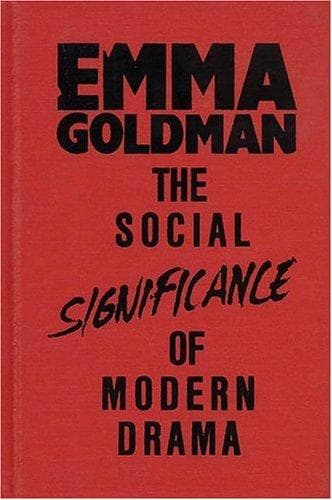
The Social Significance of the Modern DramaGoldman, Emma
History
The Social Significance of the Modern Drama
Goldman, Emma
Drama -- Social aspects; European drama -- History and criticism
The second act, in the court room, shows Justice in the very process of
manufacture. The scene equals in dramatic power and psychologic verity
the great court scene in "Resurrection." Young _Falder_, a nervous and
rather weakly youth of twenty-three, stands before the bar. _Ruth_, his
faithful sweetheart, full of love and devotion, burns with anxiety to
save the young man, whose affection for her has brought about his
present predicament. _Falder_ is defended by _Lawyer Frome_, whose
speech to the jury is a masterpiece of social philosophy. He does not
attempt to dispute the mere fact that his client had altered the check;
and though he pleads temporary aberration in his defense, the argument
is based on a social consciousness as fundamental and all-embracing as
the roots of our social ills--"the background of life, that palpitating
life which always lies behind the commission of a crime." He shows
_Falder_ to have faced the alternative of seeing the beloved woman
murdered by her brutal husband whom she cannot divorce, or of taking the
law into his own hands. He pleads with the jury not to turn the weak
young man into a criminal by condemning him to prison.
_Frome._ Men like the prisoner are destroyed daily under our law for
want of that human insight which sees them as they are, patients,
and not criminals.... Justice is a machine that, when someone has
given it a starting push, rolls on of itself.... Is this young man
to be ground to pieces under this machine for an act which, at the
worst, was one of weakness? Is he to become a member of the luckless
crews that man those dark, ill-starred ships called prisons?... I
urge you, gentlemen, do not ruin this young man. For as a result of
those four minutes, ruin, utter and irretrievable, stares him in
the face.... The rolling of the chariot wheels of Justice over this
boy began when it was decided to prosecute him.
But the chariot of Justice rolls mercilessly on, for--as the learned
Judge says--
"Your counsel has made an attempt to trace your offense back to what
he seems to suggest is a defect in the marriage law; he has made an
attempt also to show that to punish you with further imprisonment
would be unjust. I do not follow him in these flights. _The Law is
what it is_--a majestic edifice, sheltering all of us, each stone of
which rests on another. I am concerned only with its administration.
The crime you have committed is a very serious one. I cannot feel it
in accordance with my duty to Society to exercise the powers I have
in your favor. You will go to penal servitude for three years."
In prison the young, inexperienced convict soon finds himself the victim
of the terrible "system." The authorities admit that young _Falder_ is
mentally and physically "in bad shape," but nothing can be done in the
matter: many others are in a similar position, and "the quarters are
inadequate."
Public-domain text, read in full here on John Shaqi.
Reviews
Reviews
No reviews yet
Be the first to share your thoughts on this work.
Elsewhere in the archive
Join the Discussion
Join the discussion
Sign in to leave a comment or review.
Sign InorCreate an account