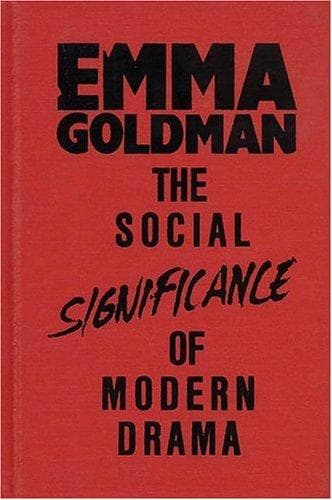
The Social Significance of the Modern DramaGoldman, Emma
History
The Social Significance of the Modern Drama
Goldman, Emma
Drama -- Social aspects; European drama -- History and criticism
_Rutherford._ Your price--your price? Damn your impudence, sir....
So that's your line, is it?... This is what I get for all I've done
for you.... This is the result of the schooling I gave you. I've
toiled and sweated to give you a name you'd be proud to own--worked
early and late, toiled like a dog when other men were taking their
ease--plotted and planned to get my chance, taken it and held it
when it come till I could ha' burst with the struggle. Sell! You
talk o' selling to me, when everything you'll ever make couldn't pay
back the life I've given to you!
_John._ Oh, I know, I know. I've been both for five years. Only I've
had no salary.
_Rutherford._ You've been put to learn your business like any other
young fellow. I began at the bottom--you've got to do the same....
Your father has lived here, and your grandfather before you. It's
your inheritance--can't you realize that?--what you've got to come
to when I'm under ground. We've made it for you, stone by stone,
penny by penny, fighting through thick and thin for close on a
hundred years.... It's what you've got to do--or starve. You're my
son--you've got to come after me.
_Janet_ knows her father better than _John_; she knows that "no one ever
stands out against father for long--or else they get so knocked about,
they don't matter any more." _Janet_ knows, and when the moment arrives
that brings her father's blow upon her head, it does not come as a
surprise to her. When old _Rutherford_ discovers her relation with
_Martin_, his indignation is as characteristic of the man as everything
else in his life. It is not outraged morality or a father's love. It is
always and forever the House of Rutherford. Moreover, the discovery of
the affair between his daughter and his workman comes at a psychologic
moment: _Rutherford_ is determined to get hold of _John's_
invention--for the Rutherfords, of course--and now that _Martin_ has
broken faith with his master, his offense serves an easy pretext for
_Rutherford_ to break faith with _Martin_. He calls the old servant to
his office and demands the receipt of _John's_ invention, entrusted to
_Martin_. On the latter's refusal to betray _John_, the master plays on
the man's loyalty to the Rutherfords.
Public-domain text, read in full here on John Shaqi.
Reviews
Reviews
No reviews yet
Be the first to share your thoughts on this work.
Elsewhere in the archive
Join the Discussion
Join the discussion
Sign in to leave a comment or review.
Sign InorCreate an account