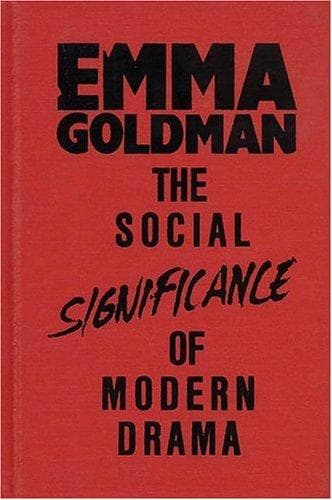
The Social Significance of the Modern DramaGoldman, Emma
History
The Social Significance of the Modern Drama
Goldman, Emma
Drama -- Social aspects; European drama -- History and criticism
_Paul Ruttledge._ But you have not told me what you have come here
for. Is there anything I can do for you?
_Mr. Green._ We have come to request you to go to the public-houses,
to stop the free drinks, to send the people back to their work. As
for those tinkers, the law will deal with them when the police
arrive.
_Paul Ruttledge._ I wanted to give a little pleasure to my
fellow-creatures.
_Mr. Dowler._ This seems rather a low form of pleasure.
_Paul Ruttledge._ I daresay it seems to you a little violent. But
the poor have very few hours in which to enjoy themselves; they must
take their pleasure raw; they haven't the time to cook it. Have we
not tried sobriety? Do you like it? I found it very dull.... Think
what it is to them to have their imagination like a blazing
tar-barrel for a whole week. Work could never bring them such
blessedness as that.
_Mr. Dowler._ Everyone knows there is no more valuable blessing than
work.
_Paul Ruttledge_ decides to put his visitors "on trial," to let them see
themselves as they are in all their hypocrisy, all their corruption.
He charges the military man, _Colonel Lawley_, with calling himself a
Christian, yet following the business of man-killing. The Colonel is
forced to admit that he had ordered his men to fight in a war, of the
justice of which they knew nothing, or did not believe in, and yet it is
"the doctrine of your Christian church, of your Catholic church, that he
who fights in an unjust war, knowing it to be unjust, loses his own
soul." Of the rich man _Dowler_, _Paul Ruttledge_ demands whether he
could pass through the inside of a finger ring, and on _Paul's_
attention being called by one of the tinkers to the fine coat of _Mr.
Dowler_, he tells him to help himself to it. Threatened by _Mr. Green_,
the spokesman of the law, with encouraging robbery, _Ruttledge_
admonishes him.
_Ruttledge._ Remember the commandment, "Give to him that asketh
thee"; and the hard commandment goes even farther, "Him that taketh
thy cloak forbid not to take thy coat also."
But the worst indictment _Ruttledge_ hurls against _Mr. Green_. The
other professed Christians kill, murder, do not love their enemies, and
do not give to any man that asks of them. But the Greens, _Rutledge_
says, are the worst of all. For the others break the law of Christ for
their own pleasure, but "you take pay for breaking it; when their goods
are taken away you condemn the taker; when they are smitten on one cheek
you punish the smiter. You encourage them in their breaking of the Law
of Christ."
Public-domain text, read in full here on John Shaqi.
Reviews
Reviews
No reviews yet
Be the first to share your thoughts on this work.
Elsewhere in the archive
Join the Discussion
Join the discussion
Sign in to leave a comment or review.
Sign InorCreate an account