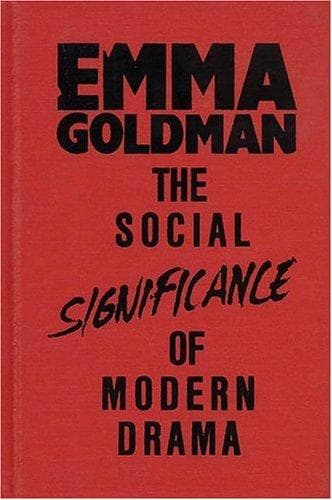
The Social Significance of the Modern DramaGoldman, Emma
History
The Social Significance of the Modern Drama
Goldman, Emma
Drama -- Social aspects; European drama -- History and criticism
For several years _Ruttledge_ lives the life of the tinkers. But of weak
physique, he finds himself unable to withstand the rigors of the road.
His health breaks down, and his faithful comrades carry him to his
native town and bring him to a monastery where _Paul_ is cared for by
the priests. While there he begins to preach a wonderful gospel, a
gospel strange to the friars and the superior,--so rebellious and
terrible that he is declared a dissenter, a heathen and a dangerous
character.
_Paul Ruttledge._ Now I can give you the message that has come to
me.... Lay down your palm branches before this altar; you have
brought them as a sign that the walls are beginning to be broken up,
that we are going back to the joy of the green earth.... For a long
time after their making men and women wandered here and there, half
blind from the drunkenness of Eternity; they had not yet forgotten
that the green Earth was the Love of God, and that all Life was the
Will of God, and so they wept and laughed and hated according to
the impulse of their hearts. They gathered the great Earth to their
breasts and their lips, ... in what they believed would be an
eternal kiss. It was then that the temptation began. The men and
women listened to them, and because when they had lived ... in
mother wit and natural kindness, they sometimes did one another an
injury, they thought that it would be better to be safe than to be
blessed, they made the Laws. The Laws were the first sin. They were
the first mouthful of the apple; the moment man had made them he
began to die; we must put out the Laws as I put out this candle. And
when they had lived amidst the green Earth that is the Love of God,
they were sometimes wetted by the rain, and sometimes cold and
hungry, and sometimes alone from one another; they thought it would
be better to be comfortable than to be blessed. They began to build
big houses and big towns. They grew wealthy and they sat chattering
at their doors; and the embrace that was to have been eternal
ended.... We must put out the towns as I put out this candle. But
that is not all, for man created a worse thing.... Man built up the
Church. We must destroy the Church, we must put it out as I put out
this candle.... We must destroy everything that has Law and Number.
The rebel is driven from the monastery. He is followed by only two
faithful friars, his disciples, who go among the people to disseminate
the new gospel. But the people fail to understand them. Immersed in
darkness and superstition, they look upon these strange men as
evildoers. They accuse them of casting an evil spell on their cattle and
disturbing the people's peace. The path of the crusader is thorny, and
_Colman_, the friar disciple of _Paul_, though faithful for a time,
become discouraged in the face of opposition and persecution. He
weakens.
Public-domain text, read in full here on John Shaqi.
Reviews
Reviews
No reviews yet
Be the first to share your thoughts on this work.
Elsewhere in the archive
Join the Discussion
Join the discussion
Sign in to leave a comment or review.
Sign InorCreate an account