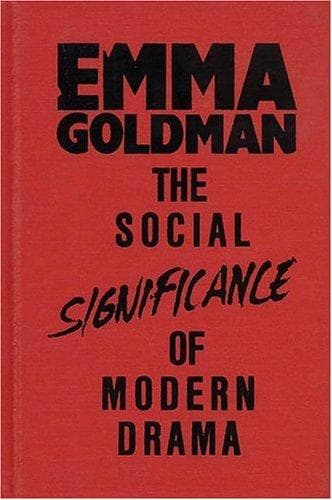
The Social Significance of the Modern DramaGoldman, Emma
History
The Social Significance of the Modern Drama
Goldman, Emma
Drama -- Social aspects; European drama -- History and criticism
_Colman._ It's no use stopping waiting for the wind; if we have
anything to say that's worth the people listening to, we must bring
them to hear it one way or another. Now, it is what I was saying to
Aloysius, we must begin teaching them to make things, they never had
the chance of any instruction of this sort here. Those and other
things, we got a good training in the old days. And we'll get a
grant from the Technical Board. The Board pays up to four hundred
pounds to some of its instructors.
_Paul Ruttledge._ Oh, I understand; you will sell them. And what
about the dividing of the money? You will need to make laws about
that. Oh, we will grow quite rich in time.
_Colman._ We'll build workshops and houses for those who come to
work from a distance, good houses, slated, not thatched.... They
will think so much more of our teaching when we have got them under
our influence by other things. Of course we will teach them their
meditations, and give them a regular religious life. We must settle
out some little place for them to pray in--there's a high gable over
there where we could hang a bell--
_Paul Ruttledge._ Oh, yes, I understand. You would weave them
together like this, you would add one thing to another, laws and
money and church and bells, till you had got everything back again
that you have escaped from. But it is my business to tear things
asunder.
_Aloysius._ Brother Paul, it is what I am thinking; now the tinkers
have come back to you, you could begin to gather a sort of an army;
you can't fight your battle without an army. They would call to the
other tinkers, and the tramps and the beggars, and the sieve-makers
and all the wandering people. It would be a great army.
_Paul Ruttledge._ Yes, that would be a great army, a great wandering
army.
_Aloysius._ The people would be afraid to refuse us then; we would
march on--
_Paul Ruttledge._ We could march on. We could march on the towns,
and we could break up all settled order; we could bring back the old
joyful, dangerous, individual life. We would have banners. We will
have one great banner that will go in front, it will take two men to
carry it, and on it we will have Laughter--
_Aloysius._ That will be the banner for the front. We will have
different troops, we will have captains to organize them, to give
them orders.
_Paul Ruttledge._ To organize? That is to bring in law and number.
Organize--organize--that is how all the mischief has been done. I
was forgetting,--we cannot destroy the world with armies; it is
inside our minds that it must be destroyed.
Deserted, _Paul Ruttledge_ stands alone in his crusade, like most
iconoclasts. Misunderstood and persecuted, he finally meets his death at
the hands of the infuriated mob.
Public-domain text, read in full here on John Shaqi.
Reviews
Reviews
No reviews yet
Be the first to share your thoughts on this work.
Elsewhere in the archive
Join the Discussion
Join the discussion
Sign in to leave a comment or review.
Sign InorCreate an account