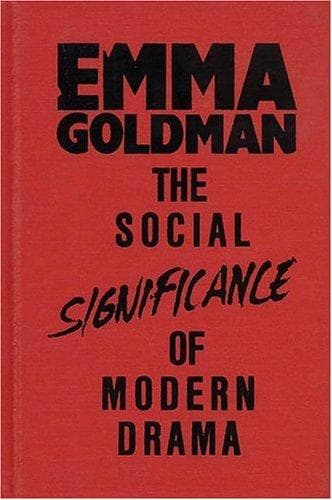
The Social Significance of the Modern DramaGoldman, Emma
History
The Social Significance of the Modern Drama
Goldman, Emma
Drama -- Social aspects; European drama -- History and criticism
"Harvest" is a grim picture of civilization in its especially
demoralizing effects upon the people who spring from the soil. The mock
culture and shallow education which inspire peasant folk with awe, which
lure the children away from home, only to crush the vitality out of them
or to turn them into cowards and compromisers. The tragedy of a
civilization that dooms the tillers of the soil to a dreary monotony of
hard toil with little return, or charms them to destruction with the
false glow of city culture and ease! Greater still this tragedy in a
country like Ireland, its people taxed to the very marrow and exploited
to the verge of starvation, leaving the young generation no opening, no
opportunity in life.
It is inevitable that the sons and daughters of Ireland, robust in body
and spirit, yearning for things better and bigger, should desert her.
For as _Mary_ says, "When the sun sets here, it's all so dark and cold
and dreary." But the young need light and warmth--and these are not in
the valley of ever-present misery and want.
"Harvest" is an expressive picture of the social background of the Irish
people, a background somber and unpromising but for the streak of dawn
that pierces that country's dark horizon in the form of the inherent and
irrepressible fighting spirit of the true Irishman, the spirit of the
Fenian revolt whose fires often slumber but are never put out, all the
ravages of our false civilization notwithstanding.
T. G. MURRAY
MAURICE HARTE
"Maurice Harte" portrays the most sinister force which holds the Irish
people in awe--that heaviest of all bondage, priestcraft.
_Michael Harte_, his wife _Ellen_, and their son _Owen_ are bent on one
purpose; to make a priest of their youngest child _Maurice_. The mother
especially has no other ambition in life than to see her son "priested."
No higher ideal to most Catholic mothers than to consecrate their
favorite son to the glory of God.
What it has cost the Hartes to attain their ambition and hope is
revealed by _Ellen Harte_ in the conversation with her sister and later
with her husband, when he informs her that he cannot borrow any more
money to continue the boy in the seminary.
_Mrs. Harte._ If Michael and myself have our son nearly a priest
this day, 'tis no small price at all we have paid for it.... Isn't
it the terrible thing, every time you look through that window, to
have the fear in your heart that 'tis the process-server you'll see
and he coming up the boreen?
_Old Harte_ impoverishes himself to enable his son to finish his
studies. He has borrowed right and left, till his resources are now
entirety exhausted. But he is compelled to try another loan.
Public-domain text, read in full here on John Shaqi.
Reviews
Reviews
No reviews yet
Be the first to share your thoughts on this work.
Elsewhere in the archive
Join the Discussion
Join the discussion
Sign in to leave a comment or review.
Sign InorCreate an account