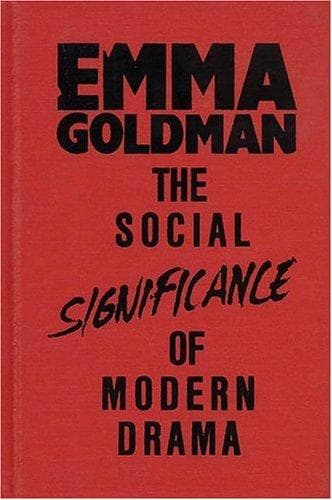
The Social Significance of the Modern DramaGoldman, Emma
History
The Social Significance of the Modern Drama
Goldman, Emma
Drama -- Social aspects; European drama -- History and criticism
There is no boundary of land or time to the resistance of the human mind
to coercion; it is worldwide. Equally so is the rebellion of youth
against the tyranny of parents. But above all does this play mirror the
self-centered, narrow, ambitious love of the mother, so disastrous to
the happiness and peace of her child. For it is _Ellen Harte_, rather
than the father, who forces _Maurice_ back to his studies. From whatever
viewpoint, however, "Maurice Harte" be considered, it carries a
dramatically powerful message of wide social significance.
THE RUSSIAN DRAMA
People outside of Russia, especially Anglo-Saxons, have one great
objection to the Russian drama: it is too sad, too gloomy. It is often
asked, "Why is the Russian drama so pessimistic?" The answer is: the
Russian drama, like all Russian culture, has been conceived in the
sorrow of the people; it was born in their woe and struggle. Anything
thus conceived cannot be very joyous or amusing.
It is no exaggeration to say that in no other country are the creative
artists so interwoven, so much at one with the people. This is not only
true of men like Turgenev, Tolstoy and the dramatists of modern times.
It applies also to Gogol, who in "The Inspector" and "Dead Souls" spoke
in behalf of the people, appealing to the conscience of Russia. The same
is true of Dostoyevsky, of the poets Nekrassov, Nadson, and others. In
fact, all the great Russian artists have gone to the people for their
inspiration, as to the source of all life. That explains the depth and
the humanity of Russian literature.
The modern drama naturally suggests Henrik Ibsen as its pioneer. But
prior to him, Gogol utilized the drama as a vehicle for popularizing the
social issues of his time. In "The Inspector," (_Revizor_) he portrays
the corruption, graft and extortion rampant in the governmental
departments. If we were to Anglicize the names of the characters in "The
Inspector," and forget for a moment that it was a Russian who wrote the
play, the criticism contained therein would apply with similar force to
present-day America, and to every other modern country. Gogol touched
the deepest sores of social magnitude and marked the beginning of the
realistic drama in Russia.
However, it is not within the scope of this work to discuss the drama of
Gogol's era. I shall begin with Tolstoy, because he is closer to our own
generation, and voices more definitely the social significance of the
modern drama.
TOLSTOY
Public-domain text, read in full here on John Shaqi.
Reviews
Reviews
No reviews yet
Be the first to share your thoughts on this work.
Elsewhere in the archive
Join the Discussion
Join the discussion
Sign in to leave a comment or review.
Sign InorCreate an account