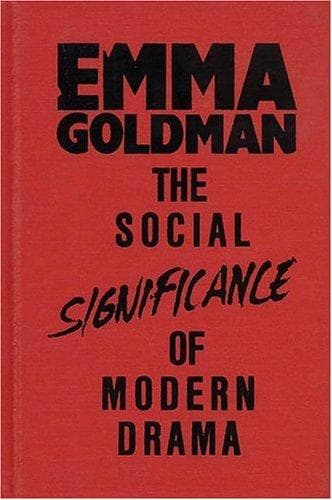
The Social Significance of the Modern DramaGoldman, Emma
History
The Social Significance of the Modern Drama
Goldman, Emma
Drama -- Social aspects; European drama -- History and criticism
When Leo Tolstoy died, the representatives of the Church proclaimed him
as their own. "He was with us," they said. It reminds one of the Russian
fable about the fly and the ox. The fly was lazily resting on the horn
of the ox while he plowed the field, but when the ox returned home
exhausted with toil, the fly bragged, "_We_ have been plowing." The
spokesmen of the Church are, in relation to Tolstoy, in the same
position. It is true that Tolstoy based his conception of human
relationships on a new interpretation of the Gospels. But he was as far
removed from present-day Christianity as Jesus was alien to the
institutional religion of his time.
Tolstoy was the last true Christian, and as such he undermined the
stronghold of the Church with all its pernicious power of darkness, with
all its injustice and cruelty.
For this he was persecuted by the Holy Synod and excommunicated from the
Church; for this he was feared by the Tsar and his henchmen; for this
his works have been condemned and prohibited.
The only reason Tolstoy himself escaped the fate of other great Russians
was that he was mightier than the Church, mightier than the ducal
clique, mightier even than the Tsar. He was the powerful conscience of
Russia exposing her crimes and evils before the civilized world.
How deeply Tolstoy felt the grave problems of his time, how closely
related he was to the people, he demonstrated in various works, but in
none so strikingly as in "The Power of Darkness."
THE POWER OF DARKNESS
"The Power of Darkness" is the tragedy of sordid misery and dense
ignorance. It deals with a group of peasants steeped in poverty and
utter darkness. This appalling condition, especially in relation to the
women folk, is expressed by one of the characters in the play:
_Mitrich._ There are millions of you women and girls, but you are
all like the beasts of the forest. Just as one has been born, so she
dies. She has neither seen or heard anything. A man will learn
something; if nowhere else, at least in the inn, or by some chance,
in prison, or in the army, as I have. But what about a woman? She
does not know a thing about God,--nay, she does not know one day
from another. They creep about like blind pups, and stick their
heads into the manure.
Public-domain text, read in full here on John Shaqi.
Reviews
Reviews
No reviews yet
Be the first to share your thoughts on this work.
Elsewhere in the archive
Join the Discussion
Join the discussion
Sign in to leave a comment or review.
Sign InorCreate an account