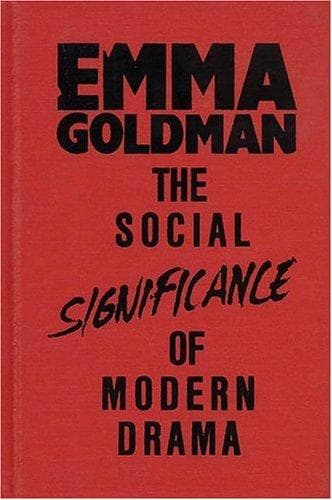
The Social Significance of the Modern DramaGoldman, Emma
History
The Social Significance of the Modern Drama
Goldman, Emma
Drama -- Social aspects; European drama -- History and criticism
When Anton Tchekhof first came to the fore, no less an authority than
Tolstoy said: "Russia has given birth to another Turgenev." The estimate
was not overdrawn. Tchekhof was indeed a modern Turgenev. Perhaps not as
universal, because Turgenev, having lived in western Europe, in close
contact with conditions outside of Russia, dealt with more variegated
aspects of life. But as a creative artist Tchekhof is fitted to take his
place with Turgenev.
Tchekhof is preëminently the master of short stories. Within the limits
of a few pages he paints the drama of human life with its manifold
tragic and comic colors, in its most intimate reflex upon the characters
who pass through the panorama. He has been called a pessimist. As if one
could miss the sun without feeling the torture of utter darkness!
Tchekhof wrote during the gloomiest period of Russian life, at a time
when the reaction had drowned the revolution in the blood of the young
generation,--when the Tsar had choked the very breath out of young
Russia. The intellectuals were deprived of every outlet: all the social
channels were closed to them, and they found themselves without hope or
faith, not having yet learned to make common cause with the people.
Tchekhof could not escape the atmosphere which darkened the horizon of
almost the whole of Russia. It was because he so intensely felt its
oppressive weight that he longed for air, for light, for new and vital
ideas. To awaken the same yearning and faith in others, he had to
picture life as it was, in all its wretchedness and horror.
This he did in "The Seagull," while in "The Cherry Orchard" he holds out
the hope of a new and brighter day.
THE SEAGULL
In "The Seagull" the young artist, _Constantine Treplef_, seeks new
forms, new modes of expression. He is tired of the old academic ways,
the beaten track; he is disgusted with the endless imitative methods, no
one apparently capable of an original thought.
_Constantine_ has written a play; the principal part is to be acted by
_Nina_, a beautiful girl with whom _Constantine_ is in love. He arranges
the first performance to take place on the occasion of his mother's
vacation in the country.
She herself--known as _Mme. Arcadina_--is a famous actress of the old
school. She knows how to show off her charms to advantage, to parade her
beautiful gowns, to faint and die gracefully before the footlights; but
she does not know how to live her part on the stage. _Mme. Arcadina_ is
the type of artist who lacks all conception of the relation between art
and life. Barren of vision and empty of heart, her only criterion is
public approval and material success. Needless to say, she cannot
understand her son. She considers him decadent, a foolish rebel who
wants to undermine the settled canons of dramatic art. _Constantine_
sums up his mother's personality in the following manner:
Public-domain text, read in full here on John Shaqi.
Reviews
Reviews
No reviews yet
Be the first to share your thoughts on this work.
Elsewhere in the archive
Join the Discussion
Join the discussion
Sign in to leave a comment or review.
Sign InorCreate an account