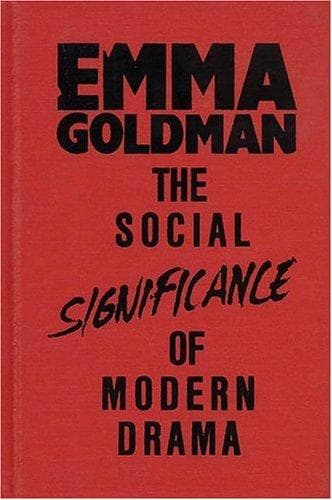
The Social Significance of the Modern DramaGoldman, Emma
History
The Social Significance of the Modern Drama
Goldman, Emma
Drama -- Social aspects; European drama -- History and criticism
As long as _Akulina's_ condition is not noticeable, the relation of
_Nikita_ with his dead master's daughter remains hidden from the
neighbors. But the time comes when she is to give birth to a child. It
is then that _Anisya_ becomes mistress of the situation again. Her
hatred for _Akulina_, her outraged love for _Nikita_ and the evil spirit
of _Nikita's_ mother all combine to turn her into a fiend. _Akulina_ is
driven to the barn, where her terrible labor pains are stifled by the
dread of her stepmother. When the innocent victim is born, _Nikita's_
vicious mother and _Anisya_ persuade him that the child is dead and
force him to bury it in the cellar.
While _Nikita_ is digging the grave, he discovers the deception. The
child is alive! The terrible shock unnerves the man, and in temporary
madness he presses a board over the little body till its bones crunch.
Superstition, horror and the perfidy of the women drive _Nikita_ to
drink in an attempt to drown the baby's cries constantly ringing in his
ears.
The last act deals with _Akulina's_ wedding to the son of a neighbor.
She is forced into the marriage because of her misfortune. The peasants
all gather for the occasion, but _Nikita_ is missing: he roams the place
haunted by the horrible phantom of his murdered child. He attempts to
hang himself but fails, and finally decides to go before the entire
assembly to confess his crimes.
_Nikita._ Father, listen to me! First of all, Marina, look at me! I
am guilty toward you: I had promised to marry you, and I seduced
you. I deceived you and abandoned you; forgive me for Christ's sake!
_Matrena._ Oh, oh, he is bewitched. What is the matter with him? He
has the evil eye upon him. Get up and stop talking nonsense!
_Nikita._ I killed your father, and I, dog, have ruined his
daughter. I had the power over her, and I killed also her baby....
Father dear! Forgive me, sinful man! You told me, when I first
started on this life of debauch: "When the claw is caught, the whole
bird is lost." But, I, dog, did not pay any attention to you, and so
everything turned out as you said. Forgive me, for Christ's sake.
The "Power of Darkness" is a terrible picture of poverty, ignorance and
superstition. To write such a work it is not sufficient to be a creative
artist: it requires a deeply sympathetic human soul. Tolstoy possessed
both. He understood that the tragedy of the peasants' life is due not to
any inherent viciousness but to the power of darkness which permeates
their existence from the cradle to the grave. Something heavy is
oppressing them--in the words of _Anisya_--weighing them down, something
that saps all humanity out of them and drives them into the depths.
"The Power of Darkness" is a social picture at once appalling and
gripping.
ANTON TCHEKHOF
Public-domain text, read in full here on John Shaqi.
Reviews
Reviews
No reviews yet
Be the first to share your thoughts on this work.
Elsewhere in the archive
Join the Discussion
Join the discussion
Sign in to leave a comment or review.
Sign InorCreate an account