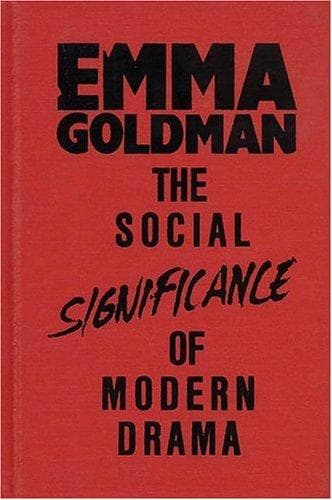
The Social Significance of the Modern DramaGoldman, Emma
History
The Social Significance of the Modern Drama
Goldman, Emma
Drama -- Social aspects; European drama -- History and criticism
_Trigorin._ What is there so fine about it? Day and night I am
obsessed by the same persistent thought; I must write, I must write,
I must write.... No sooner have I finished one story than I am
somehow compelled to write another, then a third, and after the
third a fourth.... I have no rest for myself; I feel that I am
devouring my own life.... I've never satisfied _myself_.... I have
the feeling for nature; it wakes a passion in me, an irresistible
desire to write. But I am something more than a landscape painter;
I'm a citizen as well; I love my country, I love the people; I feel
that if I am a writer I am bound to speak of the people, of its
suffering, of its future, to speak of science, of the rights of man,
etc., etc.; and I speak about it all, volubly, and am attacked
angrily in return by everyone; I dart from side to side like a fox
run down by hounds; I see that life and science fly farther and
farther ahead of me, and I fall farther and farther behind, like the
countryman running after the train; and in the end I feel that the
only thing I can write of is the landscape, and in everything else I
am untrue to life, false to the very marrow of my bones.
_Constantine_ realizes that _Nina_ is slipping away from him. The
situation is aggravated by the constant friction with his mother and his
despair at the lack of encouragement for his art. In a fit of
despondency he attempts suicide, but without success. His mother,
although nursing him back to health, is infuriated at her son's
"foolishness," his inability to adapt himself to conditions, his
impractical ideas. She decides to leave, accompanied by _Trigorin_. On
the day of their departure _Nina_ and _Trigorin_ meet once more. The
girl tells him of her ambition to become an actress, and, encouraged by
him, follows him to the city.
Two years later _Mme. Arcadina_, still full of her idle triumphs,
returns to her estate. _Trigorin_ is again with her still haunted by the
need of copy.
_Constantine_ has in the interim matured considerably. Although he has
made himself heard as a writer, he nevertheless feels that life to-day
has no place for such as he: that sincerity in art is not wanted. His
mother is with him, but she only serves to emphasize the flatness of his
surroundings. He loves her, but her ways jar him and drive him into
seclusion.
_Nina_, too, has returned to her native place, broken in body and
spirit. Partly because of the memory of her past affection for
_Constantine_, and mainly because she learns of _Trigorin's_ presence,
she is drawn to the place where two years before she had dreamed of the
beauty of an artistic career. The cruel struggle for recognition, the
bitter disappointment in her relation with _Trigorin_, the care of a
child and poor health have combined to change the romantic child into a
sad woman.
Public-domain text, read in full here on John Shaqi.
Reviews
Reviews
No reviews yet
Be the first to share your thoughts on this work.
Elsewhere in the archive
Join the Discussion
Join the discussion
Sign in to leave a comment or review.
Sign InorCreate an account