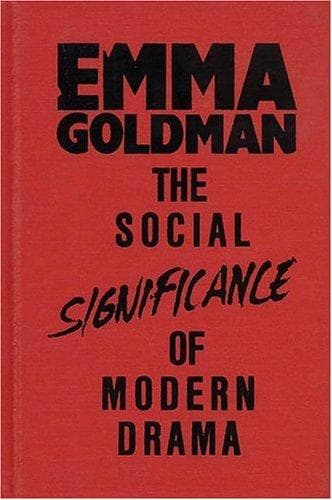
The Social Significance of the Modern DramaGoldman, Emma
History
The Social Significance of the Modern Drama
Goldman, Emma
Drama -- Social aspects; European drama -- History and criticism
_Constantine_ still loves her. He pleads with her to go away with him,
to begin a new life. But it is too late. The lure of the footlights is
beckoning to _Nina_; she returns to the stage. _Constantine_, unable to
stand the loneliness of his life and the mercenary demands upon his art,
kills himself.
* * * * *
To the Anglo-Saxon mind such an ending is pessimism,--defeat. Often,
however, apparent defeat is in reality the truest success. For is not
success, as commonly understood, but too frequently bought at the
expense of character and idealism?
"The Seagull" is not defeat. As long as there is still such material in
society as the Constantines--men and women who would rather die than
compromise with the sordidness of life--there is hope for humanity. If
the Constantines perish, it is the social fault,--our indifference to,
and lack of appreciation of, the real values that alone advance the
fuller and more complete life of the race.
THE CHERRY ORCHARD
"The Cherry Orchard" is Tchekhof's prophetic song. In this play he
depicts three stages of social development and their reflex in
literature.
_Mme. Ranevsky_, the owner of the cherry orchard, an estate celebrated
far and wide for its beauty and historic traditions, is deeply attached
to the family place. She loves it for its romanticism: nightingales sing
in the orchard, accompanying the wooing of lovers. She is devoted to it
because of the memory of her ancestors and because of the many tender
ties which bind her to the orchard. The same feeling and reverence is
entertained by her brother _Leonid Gayef_. They are expressed in the
_Ode to an Old Family Cupboard_:
_Gayef._ Beloved and venerable cupboard; honor and glory to your
existence, which for more than a hundred years has been directed to
the noble ideals of justice and virtue. Your silent summons to
profitable labor has never weakened in all these hundred years. You
have upheld the courage of succeeding generations of human kind; you
have upheld faith in a better future and cherished in us ideals of
goodness and social consciousness.
But the social consciousness of _Gayef_ and of his sister is of a
paternal nature: the attitude of the aristocracy toward its serfs. It is
a paternalism that takes no account of the freedom and happiness of the
people,--the romanticism of a dying class.
_Mme. Ranevsky_ is impoverished. The cherry orchard is heavily mortgaged
and as romance and sentiment cannot liquidate debts, the beautiful
estate falls into the cruel hands of commercialism.
The merchant _Yermolai Lopakhin_ buys the place. He is in ecstasy over
his newly acquired possession. He the owner--he who had risen from the
serfs of the former master of the orchard!
Public-domain text, read in full here on John Shaqi.
Reviews
Reviews
No reviews yet
Be the first to share your thoughts on this work.
Elsewhere in the archive
Join the Discussion
Join the discussion
Sign in to leave a comment or review.
Sign InorCreate an account